
Tying vs Tieing: Which Spelling Is Correct? refers to the difference between the correct and incorrect present participle of the verb tie. The accepted spelling is tying, while tieing is not considered standard in modern English. This follows a well-established English spelling rule that requires verbs ending in -ie to change ie to y before adding -ing. The same pattern appears in words like dying and lying, making the rule consistent across common verb forms.
One small spelling choice can shape how readers judge your writing. Whether you’re drafting a school assignment, sending a business email, publishing a blog post, or simply writing a message, using tying instead of tieing reflects accuracy and attention to detail. Even experienced writers occasionally make this mistake because the spelling seems counterintuitive at first glance.
Understanding the rule behind tying makes it easier to recognize similar spelling patterns and avoid future errors. You’ll also see how dictionaries, grammar authorities, and both British and American English consistently support the correct form. With practical examples, clear explanations, and memorable tips, you’ll gain the confidence to use tying correctly in every writing situation.
you may like:
- 28+ Funny and Unique Ways to Say “Good Morning”
- 28+ Other Ways to Say “I Appreciate It” (With Examples & Usage)
- 28+ Other Ways to Say “Thank You for the Opportunity”
Key Takeaways
Before finishing, let’s summarize the most important points.
Quick Summary
| Question | Answer |
|---|---|
| Correct spelling | Tying |
| Incorrect spelling | Tieing |
| Grammar rule | Change ie to y before adding -ing |
| Used in US English | Yes |
| Used in UK English | Yes |
| Accepted by dictionaries | Yes |
| Used in formal writing | Yes |
Quick Answer: Tying or Tieing?
Featured Snippet Answer
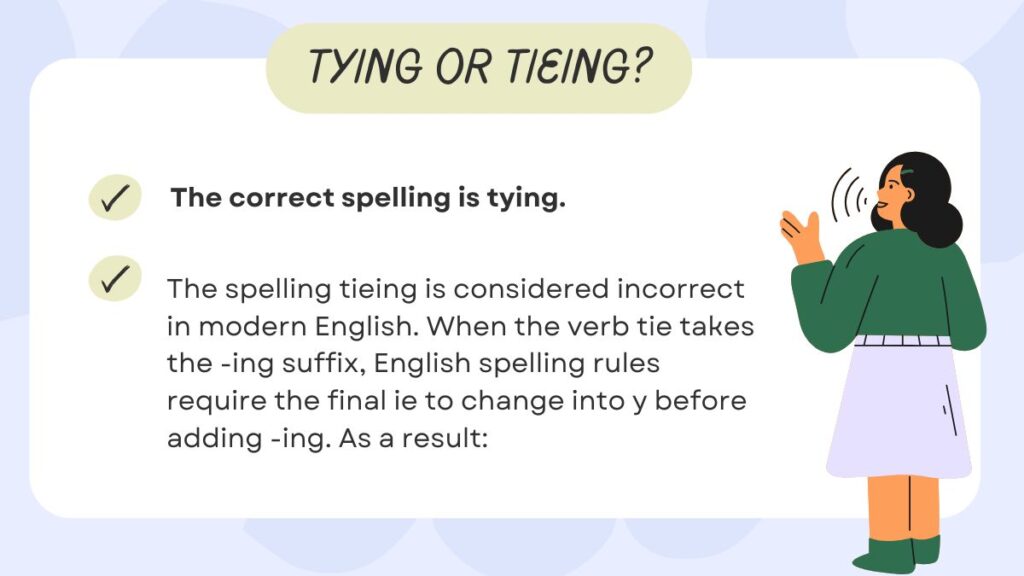
The correct spelling is tying.
The spelling tieing is considered incorrect in modern English. When the verb tie takes the -ing suffix, English spelling rules require the final ie to change into y before adding -ing. As a result:
- ✅ Tie → Tying
- ❌ Tie → Tieing
This same spelling pattern appears in other common verbs:
| Base Word | Correct Present Participle | Incorrect Form |
|---|---|---|
| Tie | Tying | Tieing |
| Die | Dying | Dieing |
| Lie | Lying | Lieing |
Both British and American English follow this rule, and major dictionaries recognize tying as the standard spelling.
Tying vs Tieing: Side-by-Side Comparison
Sometimes a quick comparison makes everything clear.
| Feature | Tying | Tieing |
|---|---|---|
| Correct spelling | ✅ Yes | ❌ No |
| Accepted in dictionaries | ✅ Yes | ❌ Generally No |
| Used in formal writing | ✅ Yes | ❌ No |
| Used in schools | ✅ Yes | ❌ No |
| Used in business writing | ✅ Yes | ❌ No |
| Used in US English | ✅ Yes | ❌ No |
| Used in UK English | ✅ Yes | ❌ No |
| Recommended by grammar guides | ✅ Yes | ❌ No |
Quick Verdict
If you’re writing in school, at work, online, or anywhere else, always choose tying.
What Does “Tying” Mean?
Understanding the meaning of tying helps you use it naturally in different situations. Although many people associate the word with shoelaces, it has several meanings depending on the context.
Tying is the present participle of the verb tie. It describes an action happening now or an ongoing activity.
For example:
- She is tying her shoes before the race.
- They are tying the boat to the dock.
- He’s tying the package with string.
In each sentence, the action is happening in the present.
Making a Knot
The most common meaning of tying is Making a Knot or fastening something securely.
Examples include:
- Tying her shoes
- Tying a necktie
- Tying a ribbon
- Tying a rope
- Tying gift wrapping
These actions involve joining or securing one object to another.
Example Sentences
- Emma is tying her shoes before soccer practice.
- The sailor spent several minutes tying the rope around the post.
- Dad finished tying the fishing line before casting it into the lake.
Fastening Objects Together
Another common use involves Fastening, securing, or holding things together.
Examples include:
- Tying curtains
- Tying balloons
- Tying boxes with twine
- Tying plants to garden stakes
This meaning appears frequently in gardening, construction, shipping, camping, and home improvement.
Connecting Ideas
The word tying isn’t limited to physical objects. Writers often use it figuratively to describe Connecting Ideas.
Examples:
- The conclusion is tying together the main arguments.
- The author is Linking ideas from earlier chapters.
- Good transitions help in Relate concepts naturally.
In writing, tying together ideas improves Logical flow, making articles easier to understand.
For example:
The final paragraph ties together every point discussed earlier, giving readers a clear conclusion.
This figurative meaning appears often in:
- Academic papers
- Essays
- Business reports
- Presentations
- Marketing content
Matching the Score in Sports
Sports commentators also use tying in a completely different way.
Here, tying means making the score equal.
Examples:
- The striker scored, tying the game at 2–2.
- Her free throw is tying the score.
- The final goal ended up tying the match.
This meaning appears across many sports, including:
- Soccer
- Basketball
- Hockey
- Baseball
- American football
Notice that the spelling remains exactly the same.
Creating Relationships or Connections
Sometimes tying refers to forming relationships or linking different elements.
Examples include:
- Tying two companies together through a merger.
- Tying customer accounts to email addresses.
- Tying software into an existing system.
Businesses, software developers, and marketers often use this meaning.
For example:
The update allows users to tie their calendar to the project management platform.
Common Phrases Using “Tying”
You’ll encounter tying in many everyday expressions.
| Phrase | Meaning |
|---|---|
| Tying the knot | Getting married |
| Tying loose ends | Finishing remaining tasks |
| Tying it all together | Connecting everything logically |
| Tying shoes | Fastening shoelaces |
| Tying a ribbon | Securing decorative ribbon |
| Tying up a boat | Securing a boat |
| Tying the score | Making both teams equal |
These phrases appear regularly in spoken and written English.
Why Is “Tying” the Correct Spelling?
you may like:
- 32+ Other Ways to Say “Have a Great Weekend”
- 29+ Other Ways to Say “I Look Forward to Meeting You”
- 25+ Other Ways to Say “Well Noted” in an Email at Work
Many spelling mistakes happen because English doesn’t always follow obvious patterns. At first glance, tieing seems logical because you simply add -ing to tie.
However, English spelling follows a different rule.
When a verb ends in -ie, those two letters usually change to y before Adding -ing.
That means:
tie
 ↓
remove "ie"
 ↓
add "y"
 ↓
add "-ing"

tying
This process prevents awkward letter combinations and keeps pronunciation consistent.
The English Grammar Rule
One of the most important Grammar Rules for verb formation is this:
When a verb ends in -ie, change the ie to y before adding -ing.
This rule applies to several common verbs.
| Base Word | Correct Form |
|---|---|
| Tie | Tying |
| Die | Dying |
| Lie | Lying |
| Untie | Untying |
Notice that every example follows exactly the same spelling pattern.
This is why Change IE to Y is such an important spelling principle.
Why Doesn’t English Use “Tieing”?
Imagine writing these words:
- tieing
- dieing
- lieing
They look awkward because the vowel combination creates unnecessary complexity.
Changing ie into y simplifies the spelling while preserving pronunciation.
English spelling has evolved over centuries to balance pronunciation, readability, and consistency. This rule is one example of that evolution.
Understanding the Word Transformation
Here’s the process step by step.
Base Word
Tie

↓

Ends in -ie

↓

Change "ie" to "y"

↓

Add "-ing"

↓

Tying
The same transformation works for similar verbs.
Die
↓

Dying
Lie
↓

Lying
Learning one spelling rule helps you spell several words correctly.
Why This Rule Matters in Everyday Writing
Whether you’re writing emails, school assignments, blog posts, or reports, using the proper spelling shows attention to detail.
Correct spelling also helps:
- Improve readability
- Build credibility
- Avoid grammar checker warnings
- Strengthen Written Communication
- Produce more professional writing
Even small spelling mistakes can distract readers.
For example:
❌ She is tieing her shoes.
Readers may immediately notice the error.
Compare that with:
✅ She is tying her shoes.
The sentence looks natural because it follows standard English conventions.
Expert Observation
One reason writers struggle with Tying vs Tieing is that many English verbs simply add -ing without changing the original spelling.
Examples include:
- Walk → Walking
- Jump → Jumping
- Read → Reading
Since tie doesn’t follow this common pattern, it’s easy to assume that tieing should be correct.
Instead, remember this simple rule:
If the verb ends in -ie, change the ie to y before adding -ing.
That single rule solves several common spelling problems at once.
Is “Tieing” Ever Correct?
This is one of the most common questions people ask after learning the spelling rule.
The short answer is no—at least not in standard modern English.
Major dictionaries, educational institutions, publishers, and style guides recognize tying as the standard spelling. If you’re writing for school, work, publishing, or everyday communication, tying is the only form you should use.
What Modern Dictionaries Say
Leading English dictionaries consistently list tying as the present participle of tie. These include respected references such as:
- Merriam-Webster
- Cambridge Dictionary
- Oxford English Dictionary
- Collins Dictionary
These dictionaries either omit tieing entirely or treat it as a nonstandard or obsolete variant rather than the preferred spelling.
Because dictionaries reflect current language usage, this provides strong evidence that tying is the accepted form in modern English.
Are There Any Historical Exceptions?
You may occasionally find tieing in:
- Very old books
- Historical documents
- Archived newspapers
- Digitized manuscripts
English spelling was less standardized in earlier centuries, so writers sometimes used different spellings for the same word. As dictionaries and educational systems became more consistent, tying emerged as the accepted standard.
Today, those historical examples don’t make tieing correct for modern writing.
Should You Ever Use “Tieing”?
For almost every situation, the answer is no.
Avoid tieing when writing:
- School assignments
- College papers
- Business emails
- Blog posts
- Professional reports
- Social media content
- Marketing materials
- Books and articles
Using tying ensures your writing matches modern English grammar, standard usage, and readers’ expectations.
Why Do People Write “Tieing” by Mistake?
If tying is the correct spelling, why do so many people type tieing?
The answer lies in how our brains process patterns. Most English verbs simply take -ing without changing the original spelling. Because of that, it’s natural to assume tie becomes tieing. Unfortunately, English has several spelling rules that override this assumption.
Let’s look at the most common reasons.
The Brain Follows the Most Common Pattern
Many verbs form the present participle by simply adding -ing.
For example:
| Base Word | Present Participle |
|---|---|
| Walk | Walking |
| Jump | Jumping |
| Play | Playing |
| Read | Reading |
| Cook | Cooking |
Since these verbs don’t change their spelling, many writers expect tie to behave the same way.
However, tie belongs to a different group of verbs. Because it ends in -ie, it follows a special Grammar Rule.
Confusion with the -ing Rule
English contains several spelling rules for adding -ing.
For example:
| Verb Ending | Rule | Example |
|---|---|---|
| Most verbs | Add -ing | Walk → Walking |
| Silent e | Drop e, then add -ing | Make → Making |
| -ie ending | Change IE to Y, then add -ing | Tie → Tying |
Many learners remember the first two rules but forget the third one.
Pronunciation Doesn’t Help
Another reason people write tieing is pronunciation.
Both tying and tieing would sound almost identical if spoken aloud.
Because English spelling isn’t entirely phonetic, pronunciation alone can’t tell you which spelling is correct.
That’s why relying on pronunciation often leads to spelling errors.
Autocorrect Doesn’t Catch Every Mistake
Modern writing tools are helpful, but they aren’t perfect.
Depending on the software you’re using:
- Some grammar checkers immediately correct tieing.
- Others simply underline it.
- A few older programs may not flag it at all.
For that reason, it’s still important to understand the spelling rule instead of depending entirely on technology.
Fast Typing Leads to Habit
People often type quickly without thinking about every letter.
If you’ve written tieing several times, your fingers may remember the incorrect version even after you’ve learned the rule.
The solution is simple:
Practice writing tying until it becomes automatic.
Correct vs Incorrect Examples
Seeing examples side by side is one of the easiest ways to remember the difference.
Everyday Examples
| ❌ Incorrect | ✅ Correct |
|---|---|
| She is tieing her shoes. | She is tying her shoes. |
| I’m tieing the package. | I’m tying the package. |
| He kept tieing knots. | He kept tying knots. |
| They’re tieing balloons together. | They’re tying balloons together. |
| We are tieing the ropes. | We are tying the ropes. |
School Writing
❌ The student was tieing the experiment together with a conclusion.
✅ The student was tying the experiment together with a strong conclusion.
Business Writing
❌ The proposal focuses on tieing several departments together.
✅ The proposal focuses on tying several departments together.
Sports
❌ The final goal was tieing the game.
✅ The final goal was tying the game.
Home and Daily Life
❌ Dad is tieing the boat.
✅ Dad is tying the boat.
More Correct Sentence Examples
Here are additional examples using tying naturally.
- Sarah is tying her shoes before class.
- The climber is tying a safety knot.
- They’re tying ribbons around the gifts.
- The teacher is tying together today’s lesson with yesterday’s discussion.
- Good transitions help in connecting ideas throughout an essay.
- The software update is tying customer records into one database.
- Volunteers spent the afternoon tying tree supports.
- The final basket ended up tying the score.
- She finished tying the package with string.
- We’re tying the decorations before the guests arrive.
These examples show that tying appears in many different contexts, not just when fastening shoelaces.
The Grammar Rule Behind “Tying”
you may like:
- 29+ Smart Alternatives to “In Addition” (Formal & Casual)
- 30+ Other Ways to Say “I Hope” in English (Formal & Informal Alternatives)
- 25+ Other Ways to Say “I Am Honored” (With Examples & Usage Tips)
- 25+ Other Ways to Say “Thank You for Your Quick Response” (With Professional Examples)
Understanding the rule is much more useful than memorizing a single word.
Once you know why tying is correct, you’ll automatically spell similar words correctly.
The Rule
When a verb ends in -ie, change the ie to y before adding -ing.
This rule applies whenever you’re creating the present participle.
Visual Breakdown
Tie
↓

Ends in -ie

↓

Change "ie" to "y"

↓

Add "-ing"

↓

Tying
The same process applies every time.
Other Words That Follow the Same Rule
The rule isn’t unique to tie.
Several common verbs behave exactly the same way.
| Base Word | Present Participle |
|---|---|
| Tie | Tying |
| Die | Dying |
| Lie | Lying |
| Untie | Untying |
Notice the consistent spelling transformation.
The IE ending always becomes Y before -ing.
Why Does English Change “IE” to “Y”?
There are two main reasons.
Improved readability
Words like tieing look awkward because of the consecutive vowels.
Changing the ending creates a cleaner spelling.
Although pronunciation stays almost the same, the spelling remains consistent across similar verbs.
English developed this convention over time, and dictionaries now recognize it as the standard form.
Are There Exceptions?
Very few common verbs ending in -ie break this rule.
For everyday writing, you can safely follow:
Ending in -ie → Change to y → Add -ing
This rule works for virtually every modern example you’ll encounter.
Words People Commonly Confuse with “Tying”
Many spelling mistakes happen because similar words serve different grammatical purposes.
Here’s a quick comparison.
| Word | Part of Speech | Example |
|---|---|---|
| Tie | Base verb | Please tie your shoes. |
| Ties | Third-person singular | He ties his shoes quickly. |
| Tied | Past tense / Past participle | She tied the ribbon yesterday. |
| Tying | Present participle | She’s tying the ribbon now. |
| Tieing | Incorrect spelling | Avoid using this form. |
Understanding each form makes writing much easier.
Tie
Tie is the original or Base Word.
Examples:
- Tie your shoes.
- Tie the package securely.
- Tie the rope to the tree.
Ties
Used with singular subjects.
Examples:
- He ties perfect fishing knots.
- She ties ribbons beautifully.
Tied
Used for completed actions.
Examples:
- They tied the boat before the storm.
- I tied my shoes five minutes ago.
Tying
Describes an action currently happening.
Examples:
- She’s tying the gift.
- They’re tying balloons together.
All Forms of the Verb “Tie”
Understanding every verb form improves both writing and speaking.
| Verb Form | Word | Example |
|---|---|---|
| Base Form | Tie | Tie your shoes. |
| Third Person Singular | Ties | She ties neat knots. |
| Simple Past | Tied | He tied the package. |
| Past Participle | Tied | The rope has been tied. |
| Present Participle | Tying | They’re tying the tent ropes. |
This table highlights the relationship between the Root Word, Verb Forms, and the Present Participle.
British vs American English: Is There Any Difference?
One of the most common questions is whether British and American English spell the word differently.
The answer is simple:
No.
Both varieties use tying.
Unlike words such as:
| US English | UK English |
|---|---|
| Color | Colour |
| Organize | Organise |
| Center | Centre |
there is no regional spelling difference between tying and tieing.
Whether you’re writing for readers in:
- United States
- United Kingdom
- Canada
- Australia
- New Zealand
the accepted spelling remains tying.
What Dictionaries and Style Guides Say
Authoritative references agree on this point.
| Authority | Preferred Form |
|---|---|
| Merriam-Webster | Tying |
| Oxford English Dictionary | Tying |
| Cambridge Dictionary | Tying |
| Collins Dictionary | Tying |
| American Heritage Dictionary | Tying |
Professional editors, publishers, universities, and teachers also follow this standard.
Style guides used in publishing and academia expect writers to use tying in formal English.
If you’re proofreading an article, essay, email, or business report, replacing tieing with tying is the correct editorial decision.
Why Following Standard Usage Matters
Correct spelling does more than satisfy grammar rules.
It also:
- Builds credibility.
- Improves readability.
- Makes your writing look more professional.
- Reduces distractions for readers.
- Helps maintain consistency across documents.
Whether you’re writing a school essay, a client proposal, a blog post, or a social media update, using the proper spelling demonstrates attention to detail.
How to Remember the Correct Spelling
Learning a spelling rule is helpful. Remembering it weeks later is even better.
Fortunately, tying follows a simple pattern that becomes easy to recall with a few practical techniques.
Memory Trick #1: Think of “Dying” and “Lying”
Most people know these words are spelled correctly:
- Dying
- Lying
Since tie, die, and lie all end in -ie, they follow the same rule.
| Base Word | Correct Form |
|---|---|
| Tie | Tying |
| Die | Dying |
| Lie | Lying |
Whenever you hesitate, remember:
If “dying” is correct, then “tying” follows the same pattern.
Memory Trick #2: Remember the Rule, Not the Word
Instead of memorizing one spelling, memorize this sentence:
When a verb ends in -ie, change the ie to y before adding -ing.
This single rule helps you spell several words correctly throughout your life.
Memory Trick #3: Picture the Transformation
Visual learners often remember spelling more easily through patterns.
Tie
↓

IE disappears

↓

Y appears

↓

Tying
Seeing the transformation makes it much easier to recall later.
Memory Trick #4: Read It Aloud During Proofreading
Before submitting an email, essay, or report, read your writing slowly.
Ask yourself:
- Does this word end in -ie?
- Am I adding -ing?
- Did I change ie to y?
This quick check takes only a few seconds.
Quick Spelling Checklist
Before publishing anything, ask yourself:
- ✅ Did I write tying, not tieing?
- ✅ Does the verb end in -ie?
- ✅ Did I change ie to y?
- ✅ Does the sentence sound natural?
- ✅ Did my grammar checker confirm the spelling?
Following this checklist can eliminate one of the most common spelling mistakes in English.
Common Mistakes Writers Make
Even experienced writers occasionally make spelling errors. Fortunately, most mistakes involving Tying vs Tieing are easy to avoid once you understand the rule.
Writing “Tieing”
This is by far the most common mistake.
❌ She is tieing her shoes.
✅ She is tying her shoes.
Forgetting the -ie Rule
Some writers remember to add -ing but forget to replace ie with y.
Learning the rule prevents this error across multiple words.
Confusing Verb Forms
Each verb form has its own purpose.
| Incorrect Usage | Correct Usage |
|---|---|
| She tying yesterday. | She tied it yesterday. |
| He tied the rope now. | He is tying the rope now. |
Understanding tense is just as important as spelling.
Relying Entirely on Spell Check
Grammar tools are useful, but they shouldn’t replace your own understanding.
Proofreading remains one of the best writing habits.
Mixing Physical and Figurative Meanings
Remember that tying doesn’t always refer to knots.
Examples:
- Tying shoes
- Tying ropes
- Tying together ideas
- Tying customer accounts
- Tying the score
Understanding context improves both grammar and vocabulary.
Best Practices for Accurate Writing
Strong writing isn’t just about avoiding mistakes. It’s about developing habits that improve clarity and professionalism.
Learn Spelling Patterns
Instead of memorizing hundreds of individual words, learn the spelling rules behind them.
This approach makes it easier to spell unfamiliar words correctly.
Proofread Slowly
Reading too quickly often causes your brain to overlook errors.
Try reading one sentence at a time.
You’ll catch more spelling mistakes.
Use Trusted References
When you’re unsure about a word, consult reliable sources such as:
- Merriam-Webster Dictionary
- Oxford English Dictionary
- Cambridge Dictionary
- Collins Dictionary
These references reflect current standard English usage.
Don’t Depend Solely on AI or Grammar Software
Writing tools can improve your work, but they aren’t perfect.
Always review important documents yourself before sending or publishing them.
Expert Tips for Remembering the Rule
Professional editors often recommend learning spelling patterns instead of memorizing isolated words.
Here are a few practical tips.
Group Similar Words Together
Instead of learning:
- tying
learn:
- tying
- dying
- lying
- untying
Grouping related words strengthens memory.
Practice Writing Complete Sentences
Instead of copying the word repeatedly, write full sentences.
Examples:
- I’m tying my running shoes.
- They’re tying balloons for the party.
- She’s tying the presentation together with a strong conclusion.
This creates stronger long-term recall.
Notice the Rule While Reading
Every time you encounter tying in a book, article, or website, pause for a moment.
Recognizing the pattern repeatedly reinforces it naturally.
Real-World Examples
Here are examples showing how tying appears across different situations.
Everyday Life
Mia is tying her shoes before leaving for school.
Workplace
The project manager is tying together updates from each department into one report.
Education
The teacher ended the lesson by tying today’s topic to last week’s discussion.
Sports
The striker scored in the final minute, tying the match.
Outdoor Activities
The camper spent several minutes tying the tent securely before the storm arrived.
These examples demonstrate that tying has both literal and figurative meanings.
Mini Case Study: Why One Letter Matters
Imagine two job applicants submitting identical résumés.
Applicant A writes:
Experience tieing safety equipment.
Applicant B writes:
Experience tying safety equipment.
Although the difference is only one letter, Applicant B demonstrates a stronger command of standard written English.
Small spelling choices influence first impressions in:
- Job applications
- Academic assignments
- Professional emails
- Business proposals
- Marketing materials
Attention to detail reflects professionalism.
Practice Quiz
Test your understanding before moving on.
Choose the Correct Word
1. She is _____ her shoes.
- A. Tieing
- B. Tying
✅ Answer: B
2. They are _____ balloons together.
- A. Tying
- B. Tieing
✅ Answer: A
3. Which spelling follows the English rule?
- A. Tieing
- B. Tying
✅ Answer: B
4. Which word changes ie to y?
- A. Tie
- B. Walk
✅ Answer: A
5. Which sentence is correct?
A.
He’s tieing the package.
B.
He’s tying the package.
✅ Answer: B
Remember These Rules
- Tying is the accepted modern spelling.
- Tieing is considered incorrect in standard English.
- Verbs ending in -ie change to y before adding -ing.
- The same rule applies to dying and lying.
- Both American and British English use tying.
Frequently Asked Questions
Is it tying or tieing?
The correct spelling is tying. Standard dictionaries and grammar guides recognize tying as the correct present participle of the verb tie.
Why is tieing incorrect?
English spelling rules require verbs ending in -ie to change ie into y before adding -ing. That’s why tie becomes tying, not tieing.
Is tieing a real word?
In modern standard English, tieing is not the accepted spelling. You may occasionally see it in older historical texts, but contemporary dictionaries and style guides recommend tying.
Does this rule apply in both the United States and the United Kingdom?
Yes. Both US English and UK English use tying.
Does tying always mean making a knot?
No.
Depending on the context, tying can mean:
- Fastening objects together
- Securing ropes
- Tying shoelaces
- Matching the score in sports
- Connecting ideas in writing
- Linking systems, accounts, or concepts
What other words follow the same spelling rule?
Several common verbs follow this pattern.
- Die → Dying
- Lie → Lying
- Untie → Untying
Why do grammar checkers flag “tieing”?
Most grammar tools compare words against modern dictionaries and standard usage. Because tieing isn’t the accepted spelling, they recommend tying instead.
What’s the difference between tie, tied, and tying?
- Tie – base form
- Tied – past tense and past participle
- Tying – present participle used for ongoing actions
Each form serves a different grammatical purpose.
How can I avoid making this mistake?
Remember one simple rule:
If a verb ends in -ie, change the ie to y before adding -ing.
With a little practice, using tying will become second nature.
Conclusion
The debate over Tying vs Tieing has a clear answer: tying is the correct spelling in modern English. While tieing may seem logical at first glance, it doesn’t follow the established English spelling rule for verbs ending in -ie.
By remembering to change IE to Y before adding -ing, you’ll not only spell tying correctly but also avoid similar mistakes with words like dying and lying.
Whether you’re tying her shoes, writing an academic paper, preparing a business report, or connecting ideas in an essay, using the correct form strengthens your writing and reflects attention to detail.
Spelling may seem like a small detail, but clear, accurate language builds trust with your readers. Master this simple rule once, and you’ll never have to second-guess tying again.

Hi, I’m Daniel Foster. I write about word meanings, slang terms, acronyms, and other ways to say common phrases. Through OverallWays, I help readers understand modern language and communicate more effectively with clear and informative content.
