
Have you ever typed “Thank You for Your Quick Response” and wondered if there was a better way to say it?
You’re not alone.
Whether you’re writing a business email, replying to a client, thanking a coworker, or responding to customer support, using the same phrase repeatedly can make your communication sound repetitive. Choosing the right words shows professionalism, strengthens relationships, and leaves a positive impression.
The good news is that English offers plenty of alternatives. Some sound more formal, while others are warm, friendly, or perfect for everyday conversations.
In this guide, you’ll discover 25+ Other Ways to Say “Thank You for Your Quick Response”, when to use each expression, and real-life examples you can copy into your emails. You’ll also learn the difference between formal and casual appreciation phrases, common mistakes to avoid, and expert tips for writing better thank-you messages.
Key Takeaway: The best appreciation message isn’t always the most formal one. It’s the phrase that matches your audience, situation, and tone.
Key Takeaways
Here’s a quick summary of everything covered in this guide.
- Thank You for Your Quick Response is professional and widely accepted.
- Using different appreciation phrases keeps your communication fresh.
- Match your wording to your audience and the level of formality.
- Mention why the quick reply was helpful whenever possible.
- Keep your message concise, sincere, and specific.
- Personalization creates stronger professional relationships.
- Rotating between formal and casual alternatives improves your writing naturally.
What Does “Thank You for Your Quick Response” Mean?
The phrase “Thank You for Your Quick Response” expresses gratitude to someone who replied promptly. It recognizes the other person’s effort and acknowledges that they responded sooner than expected.
You’ll often see this phrase in:
- Business emails
- Customer support conversations
- Workplace communication
- College or university emails
- Client communication
- Sales follow-ups
- Professional networking
Using a sincere gratitude expression like this demonstrates respect and professionalism. It also encourages positive communication because people appreciate having their efforts recognized.
Why This Phrase Matters
Fast replies often help people:
- Meet deadlines
- Solve urgent problems
- Continue projects
- Make quicker decisions
- Improve teamwork
A simple thank you message can strengthen professional relationships and encourage future cooperation.
Why You Should Sometimes Use an Alternative
Although the phrase is perfectly correct, using it repeatedly can sound mechanical.
Instead, varying your wording makes your professional writing feel more natural.
For example:
Instead of writing:
Thank you for your quick response.
You might write:
- Thanks for getting back to me so quickly.
- I appreciate your prompt reply.
- Your prompt reply is greatly appreciated.
- Thank you for responding promptly.
Each version communicates appreciation while creating a more engaging reading experience.
When Should You Use an Alternative?
Different situations call for different tones.
A message to your manager shouldn’t sound exactly like a message to your best friend.
Choosing the right phrase improves your communication skills, supports proper email etiquette, and helps you build stronger professional relationships.
Professional Emails
Professional emails usually require respectful, polished language.
Examples include:
- Job applications
- Client communication
- Vendor discussions
- Internal company emails
- HR conversations
Here, phrases like “Thank You for Your Prompt Response” or “I appreciate your prompt response” sound polished without being overly formal.
Workplace Communication
Daily office conversations often feel slightly less formal.
If you’re thanking a teammate for answering quickly, these work well:
- Thanks for your quick response
- Thanks for getting back to me
- Thank you for your quick assistance
- Thanks for the quick turnaround
These expressions sound professional while remaining friendly.
Customer Service Responses
Customer support teams usually respond to many emails every day.
Showing appreciation creates a positive interaction.
Good choices include:
- Thank you for your prompt support
- Thank you for your efficient response
- Thanks for your helpful response
- Thank you for your immediate attention
These phrases recognize both speed and helpfulness.
Business Communication
In formal business communication, wording matters.
Clients often notice professionalism in small details.
Instead of always saying Thank You for Your Fast Response, consider:
- Many thanks for your prompt attention
- Your prompt attention is appreciated
- Thank you for your timely response
- Thank you for responding without delay
These expressions sound confident and polished.
Academic Communication
Students frequently email:
- Professors
- Admissions offices
- Academic advisors
- Research supervisors
A respectful tone is important.
Examples include:
- Thank you for your timely response.
- I sincerely appreciate your timely response.
- Thank you for replying so quickly.
Casual Conversations
Not every conversation needs formal language.
When texting friends or coworkers, simple expressions often sound better.
For example:
- Thanks!
- Thanks for getting back to me quickly.
- Appreciate your fast feedback.
- Thanks for responding so quickly.
Simple doesn’t mean unprofessional. It means natural.
Quick Comparison Table: Which Phrase Fits Your Situation?
| Situation | Recommended Phrase | Tone |
|---|---|---|
| Business Email | Thank You for Your Prompt Response | Formal |
| Client Communication | Many thanks for your prompt attention | Professional |
| Manager | I appreciate your prompt response | Respectful |
| Coworker | Thanks for your quick response | Friendly |
| Customer Support | Thank you for your prompt support | Professional |
| Job Interview | Thank you for responding promptly | Formal |
| Professor | I sincerely appreciate your timely response | Respectful |
| Friend | Thanks for getting back to me quickly | Casual |
This table can help you choose the right wording without overthinking every email.
Other Ways to Say “Thank You for Your Quick Response”
Below are professional, polite, and natural alternatives you can start using immediately.
Each phrase includes:
- Best use case
- Tone
- Example
Thank you for getting back to me so quickly.
Best for: Professional emails and everyday workplace communication
Tone: Friendly and professional
This is one of the safest alternatives because it feels conversational while maintaining professionalism.
Example
Thank you for getting back to me so quickly. Your clarification helped me move forward with the project.
I appreciate your prompt reply.
Best for: Business correspondence
Tone: Formal
This phrase sounds slightly more polished than a simple thank-you. It works especially well in executive or client emails.
Example
I appreciate your prompt reply. Your feedback answered all of my questions.
Thanks for the quick reply.
Best for: Internal office communication
Tone: Casual professional
This alternative works well between coworkers who communicate regularly.
Example
Thanks for the quick reply. I’ll update the report today.
Thank you for responding so promptly.
Best for: Formal workplace communication
Tone: Professional
This expression emphasizes both appreciation and professionalism.
Example
Thank you for responding so promptly. Your assistance is greatly appreciated.
Thanks for your fast response.
Best for: Friendly business emails
Tone: Semi-formal
This phrase is short and direct. It fits routine communication without sounding stiff.
Example
Thanks for your fast response. It helped us meet today’s deadline.
I appreciate your timely response.
Best for: Clients, managers, and professors
Tone: Respectful
Unlike “quick,” the word timely also suggests that the response arrived exactly when it was needed.
Example
I appreciate your timely response. Your guidance made the next steps much clearer.
Thank you for your swift reply.
Best for: Formal correspondence
Tone: Elegant and professional
The word swift adds variety without sounding unnatural.
Example
Thank you for your swift reply. We can now proceed with the agreement.
Thanks for replying so quickly.
Best for: Everyday conversations
Tone: Friendly
This is a simple expression that sounds genuine and approachable.
Example
Thanks for replying so quickly. I really appreciate your help.
I appreciate your prompt attention.
Best for: Urgent matters
Tone: Professional
Rather than focusing only on speed, this phrase recognizes the person’s willingness to prioritize your request.
Example
I appreciate your prompt attention to this matter. Your support has been extremely helpful.
Thank you for the speedy response.
Best for: Customer support and service communication
Tone: Friendly professional
This alternative sounds energetic while remaining appropriate for professional settings.
Example
Thank you for the speedy response. I’m glad the issue was resolved so quickly.
Key Takeaways
Before choosing a phrase, remember these simple guidelines:
- Match your wording to the recipient.
- Formal situations require more polished language.
- Casual conversations sound better with shorter expressions.
- Genuine appreciation matters more than complicated vocabulary.
- Avoid repeating the exact same phrase in every email.
A thoughtful appreciation message makes your business correspondence, office communication phrases, and professional email templates more engaging. Even a small change in wording can improve your overall effective communication and help build stronger professional relationships.
Expert Insight: The most memorable emails rarely use complicated language. They use clear, sincere, and audience-appropriate words that make the recipient feel genuinely appreciated.
Thank You for Your Immediate Reply.
Best for: Urgent business matters, project updates, and time-sensitive requests
Tone: Professional and appreciative
This phrase works well when someone responds almost instantly. It highlights both the speed and the value of their reply.
Example
Thank you for your immediate reply. Your information helped us finalize today’s presentation.
I Appreciate You Getting Back to Me Promptly.
Best for: Workplace emails and client communication
Tone: Warm and professional
This expression feels more conversational than some formal alternatives while still sounding respectful.
Example
I appreciate you getting back to me promptly. Your feedback answered every question I had.
Thank You for the Quick Follow-Up.
Best for: Sales, customer support, and ongoing projects
Tone: Professional
A follow-up often keeps projects moving. Acknowledging that effort helps build stronger professional relationships.
Example
Thank you for the quick follow-up. Your update helped us stay on schedule.
Thanks for Responding Right Away.
Best for: Internal team communication
Tone: Friendly
This phrase feels natural without losing professionalism.
Example
Thanks for responding right away. We can move ahead with the next phase.
I Appreciate Your Responsiveness.
Best for: Managers, executives, clients, and long-term business partners
Tone: Formal
Instead of focusing on one reply, this phrase recognizes someone’s consistent habit of replying quickly.
Example
I appreciate your responsiveness. It’s always a pleasure working with someone so reliable.
Thank You for Your Efficient Reply.
Best for: Professional correspondence
Tone: Respectful
This expression thanks someone not only for replying quickly but also for providing useful information.
Example
Thank you for your efficient reply. Your detailed explanation solved the issue immediately.
Thanks for Addressing This So Quickly.
Best for: Customer support and problem resolution
Tone: Professional yet friendly
This wording emphasizes action rather than simply replying.
Example
Thanks for addressing this so quickly. We truly appreciate your assistance.
I Appreciate the Quick Turnaround.
Best for: Design approvals, legal documents, reports, and project reviews
Tone: Business professional
The phrase “quick turnaround” is common in professional environments where deadlines matter.
Example
I appreciate the quick turnaround. It allowed us to meet our client’s deadline.
Thank You for Your Rapid Response.
Best for: Formal business communication
Tone: Formal
Although less common than “prompt response,” this alternative works well in formal writing.
Example
Thank you for your rapid response. Your prompt assistance made a significant difference.
Thanks for Your Timely Assistance.
Best for: Client communication and workplace collaboration
Tone: Professional
This expression recognizes both speed and helpfulness.
Example
Thanks for your timely assistance. We appreciate your continued support.
I Appreciate Your Quick Clarification.
Best for: Questions, corrections, and technical discussions
Tone: Professional
Sometimes a fast clarification prevents expensive mistakes.
Example
I appreciate your quick clarification. Everything is much clearer now.
Thank You for the Fast Update.
Best for: Project management and ongoing conversations
Tone: Friendly professional
Updates help teams make informed decisions.
Example
Thank you for the fast update. We’ll adjust our schedule accordingly.
Thanks for Your Prompt Assistance.
Best for: Customer service and business emails
Tone: Professional
This phrase combines gratitude with recognition of helpful support.
Example
Thanks for your prompt assistance. We truly value your help.
I Appreciate Your Immediate Attention.
Best for: Urgent requests
Tone: Formal
This wording is especially useful when someone prioritizes your issue.
Example
I appreciate your immediate attention to this matter. Your support is greatly appreciated.
Thank You for Responding Without Delay.
Best for: Executive communication
Tone: Formal
This alternative sounds polished and professional.
Example
Thank you for responding without delay. Your guidance helped us avoid unnecessary delays.
Many Thanks for Your Prompt Response.
Best for: International business communication
Tone: Formal but warm
This phrase is widely used in British and international business English, though it also works well in American professional emails.
Example
Many thanks for your prompt response. We look forward to working together.
Thank You for Your Quick Support.
Best for: Customer support teams, IT departments, and service providers
Tone: Friendly professional
This wording acknowledges both responsiveness and assistance.
Example
Thank you for your quick support. Everything is working perfectly now.
Formal Alternatives for Business Emails
Choosing the right phrase depends on your audience.
The table below helps you decide quickly.
| Recipient | Recommended Phrase | Professional Level |
|---|---|---|
| CEO | I appreciate your prompt response. | Very Formal |
| Client | Many thanks for your prompt attention. | Formal |
| Manager | Thank you for your timely response. | Formal |
| Coworker | Thanks for your quick response. | Semi-formal |
| Customer | Thank you for your prompt support. | Professional |
| Professor | I sincerely appreciate your timely response. | Respectful |
| Recruiter | Thank you for responding promptly. | Formal |
Best Phrases for Clients
Clients appreciate professionalism.
Good choices include:
- Thank You for Your Prompt Response
- Thank You for Your Timely Response
- I Appreciate Your Prompt Response
- Your Prompt Reply Is Greatly Appreciated
- Thank You for Your Efficient Communication
These phrases maintain excellent business communication while sounding sincere.
Best Phrases for Managers
Managers usually expect respectful language.
Excellent choices include:
- Thank You for Your Immediate Response
- Thank You for Your Prompt Response
- I Appreciate Your Prompt Reply
- Thank You for Responding Promptly
- Many Thanks for Your Prompt Attention
Best Phrases for Executives
Executive communication should be concise.
Examples include:
- Thank you for your timely response.
- I sincerely appreciate your prompt reply.
- Your prompt attention is appreciated.
- Thank you for responding without delay.
Best Phrases for Professors
Academic communication requires courtesy.
Recommended expressions include:
- Thank you for replying so quickly.
- I sincerely appreciate your timely response.
- Thank you for your prompt guidance.
- I appreciate your helpful feedback.
- What Kind vs What Kinds: 29+ Correct Alternatives and When to Use Them
- 29+ Professional Ways to Say “Good Luck in Your Future Endeavors”
- Trash vs Garbage: Meaning, Differences, and Real-Life Usage
Casual Alternatives for Everyday Conversations
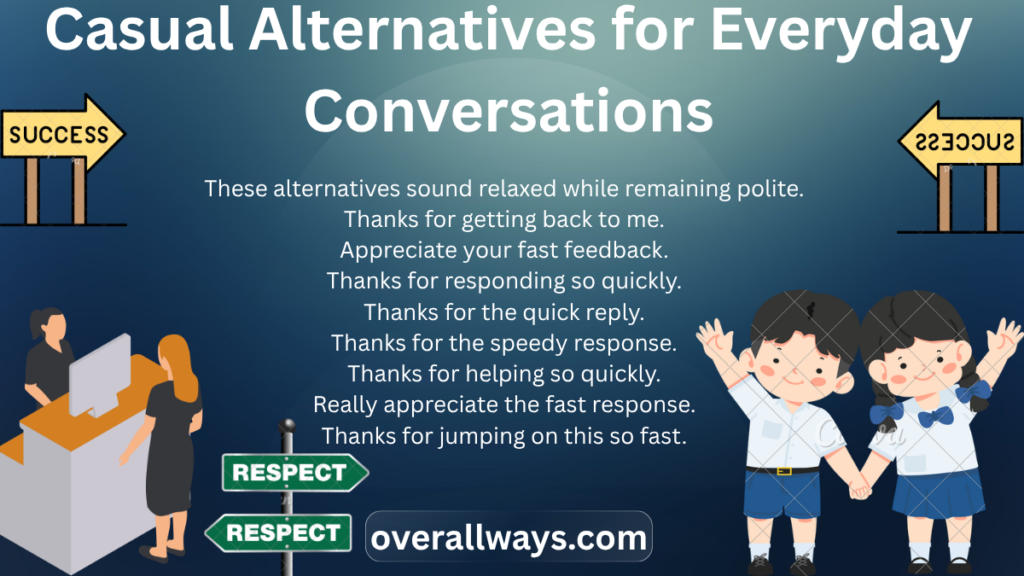
Not every conversation requires business language.
These alternatives sound relaxed while remaining polite.
- Thanks for getting back to me.
- Appreciate your fast feedback.
- Thanks for responding so quickly.
- Thanks for the quick reply.
- Thanks for the speedy response.
- Thanks for helping so quickly.
- Really appreciate the fast response.
- Thanks for jumping on this so fast.
These work well in messaging apps, Slack, Microsoft Teams, or friendly emails.
Real-World Email Examples
Sometimes readers don’t want individual phrases.
They want complete responses they can use immediately.
Business Email Example
Hi Sarah,
Thank you for your prompt response. I appreciate the detailed information you shared regarding the proposal.
Your clarification answered all of our questions, and we’ll move forward with the next steps this afternoon.
Thank you again for your continued support.
Best regards,
James
Client Communication Example
Dear Mr. Wilson,
Many thanks for your prompt attention.
Your quick reply allowed us to finalize today’s agreement ahead of schedule.
We appreciate your professionalism and look forward to continuing our partnership.
Kind regards,
Job Interview Follow-Up Example
Dear Hiring Manager,
Thank you for responding so promptly.
I appreciate the update regarding my application and look forward to the next stage of the hiring process.
Thank you once again for your time.
Customer Service Example
Hello,
Thank you for your quick assistance.
Your team resolved my issue much faster than expected, and I genuinely appreciate the excellent service.
Internal Workplace Email Example
Hi Team,
Thanks for the quick turnaround.
Everyone’s prompt responses helped us complete the project before the deadline.
Great work!
Common Mistakes to Avoid
Even experienced professionals make mistakes when writing professional email phrases.
Avoid these common problems.
| Mistake | Better Approach |
|---|---|
| Repeating the same phrase in every email | Rotate between different alternatives |
| Being too casual with executives | Match the recipient’s formality |
| Writing long thank-you messages | Keep appreciation concise |
| Forgetting personalization | Mention what helped you |
| Using robotic wording | Write naturally |
Best Practices for Writing Better Thank-You Emails
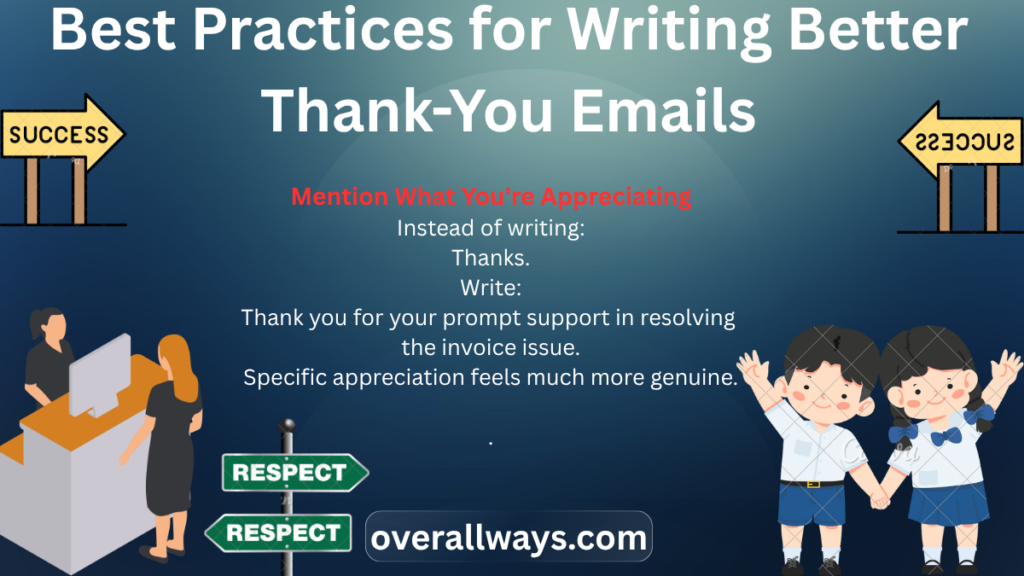
Professional writers often follow a simple framework.
Mention What You’re Appreciating
Instead of writing:
Thanks.
Write:
Thank you for your prompt support in resolving the invoice issue.
Specific appreciation feels much more genuine.
Match the Recipient’s Tone
Formal email?
Use formal language.
Friendly coworker?
A relaxed tone usually works better.
Keep It Brief
A thank-you message doesn’t need to be long.
Often, two or three thoughtful sentences create a stronger impression than a lengthy paragraph.
Personalize Your Response
Adding one sentence explaining why the quick reply mattered makes your message far more meaningful.
Example:
Thank you for your timely response. Because of your quick feedback, we were able to submit the proposal before today’s deadline.
That single sentence transforms a standard acknowledgment message into genuine appreciation.
Expert Tips to Make Your Thank-You Messages More Genuine
A simple thank you message can acknowledge someone’s effort. A thoughtful message, however, builds trust, strengthens relationships, and encourages future collaboration.
Whether you’re communicating with a client, colleague, manager, recruiter, or customer support representative, these expert tips will help your appreciation sound authentic instead of automatic.
Mention Exactly What Helped You
Generic appreciation is polite, but specific appreciation is memorable.
Instead of writing:
Thank you for your quick response.
Write:
Thank you for your quick response. Your clarification about the project timeline helped our team finalize the schedule before today’s meeting.
This approach tells the recipient that their reply made a real difference.
Why It Works
People like knowing their time and effort had value. Adding one sentence of context makes your message more meaningful.
Match the Level of Formality
Not every conversation requires the same tone.
Use formal language when emailing:
- Clients
- Executives
- Professors
- Recruiters
- Government organizations
A friend or close coworker usually appreciates a more relaxed style.
Quick Guide
| Recipient | Recommended Tone |
|---|---|
| Client | Formal |
| Manager | Professional |
| Coworker | Friendly Professional |
| Friend | Casual |
| Customer Support | Professional |
| Professor | Respectful |
Matching the recipient’s tone is one of the simplest ways to improve your business communication and workplace communication.
Keep Your Appreciation Concise
Long thank-you emails often reduce the impact of your message.
A clear structure works best:
- Thank the person.
- Mention what helped.
- State the next step (if applicable).
Example
Thank you for your prompt response. Your update answered my questions, and I’ll proceed with the next phase this afternoon.
Three sentences are often enough.
Personalize Whenever Possible
Small details make messages feel genuine.
Instead of:
Thanks for your reply.
Try:
Thank you for your immediate attention. I especially appreciate how clearly you explained the revised pricing options.
Personalization shows genuine appreciation rather than routine politeness.
End on a Positive Note
Closing your message professionally leaves a lasting impression.
Examples include:
- I appreciate your continued support.
- Looking forward to working with you.
- Thanks again for your assistance.
- I look forward to your continued guidance.
- Wishing you a wonderful day.
These endings reinforce positive client communication and business correspondence.
- Countrys vs Countries: Which Spelling Is Correct?
- Cancellation vs Cancelation: The Correct Spelling (US vs UK)
- 27+ Other Ways to Say “Looking Forward to Seeing You”
Step-by-Step Framework for Writing a Professional Thank-You Message
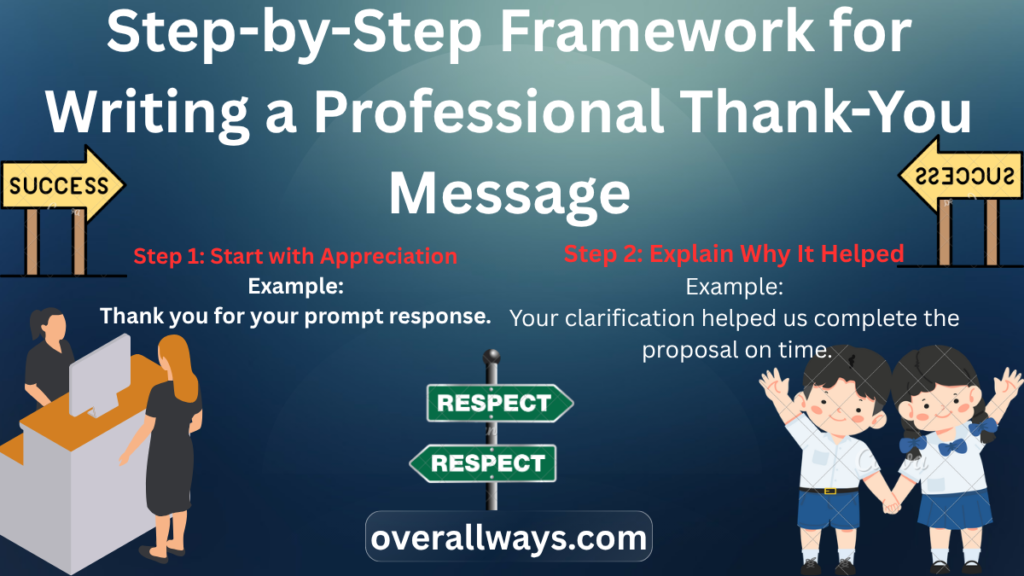
If you’re unsure what to write, follow this simple framework.
Step 1: Start with Appreciation
Example:
Thank you for your prompt response.
Step 2: Explain Why It Helped
Example:
Your clarification helped us complete the proposal on time.
Step 3: Mention the Next Step
Example:
We’ll review the remaining details and send the final version tomorrow.
Step 4: End Politely
Example:
Thank you again. I appreciate your continued support.
Professional Thank-You Email Template
Hello [Name],

Thank you for your prompt response.

I appreciate the time you took to answer my questions. Your information helped me move forward with confidence.

Thank you again for your assistance. I look forward to working with you.

Best regards,

[Your Name]
This template works well for clients, coworkers, recruiters, and vendors.
Case Study: Why Better Appreciation Improves Professional Relationships
Imagine two employees sending emails after receiving quick feedback.
Employee A
Thanks.
The message is polite but forgettable.
Employee B
Thank you for your timely response. Your suggestions helped us complete the report ahead of schedule. I appreciate your continued support.
Both employees expressed gratitude.
However, the second message:
- Shows professionalism.
- Recognizes the recipient’s contribution.
- Builds goodwill.
- Encourages future collaboration.
Over time, these small communication habits strengthen workplace relationships and improve overall effective communication.
Formal vs. Casual Appreciation Phrases
Choosing the right tone can make your email feel more natural.
| Formal Expressions | Casual Expressions |
|---|---|
| Thank You for Your Prompt Response | Thanks for your quick reply |
| Thank You for Your Timely Response | Thanks for getting back to me |
| I Appreciate Your Prompt Response | Appreciate your fast feedback |
| Your Prompt Reply Is Greatly Appreciated | Thanks for responding so quickly |
| Thank You for Responding Promptly | Thanks for the speedy response |
| Thank You for Your Immediate Attention | Thanks for jumping on this so quickly |
This comparison makes it easier to choose the right phrase based on the situation.
Quick Checklist Before Sending Your Email
Use this checklist to improve every appreciation email.
- ✅ Choose a phrase that matches the recipient.
- ✅ Mention what you’re thankful for.
- ✅ Keep the message concise.
- ✅ Use clear, natural language.
- ✅ Avoid repeating the same wording in every email.
- ✅ Proofread for grammar and spelling.
- ✅ End with a polite closing.
Following these simple steps improves your professional writing, email etiquette, and overall communication skills.
Frequently Asked Questions
How do you say thank you for your quick response professionally?
Professional alternatives include:
- Thank You for Your Prompt Response
- I Appreciate Your Prompt Response
- Thank You for Responding Promptly
- Thank You for Your Timely Response
- Many Thanks for Your Prompt Attention
These phrases work well in business emails, client communication, and workplace correspondence.
What is another way to say thank you for your prompt response?
Some excellent alternatives are:
- Thank you for getting back to me so quickly.
- Thank you for your swift reply.
- Your prompt reply is greatly appreciated.
- I appreciate your responsiveness.
- Thank you for your efficient response.
- Thank you for your immediate reply.
Each one conveys appreciation while adding variety to your writing.
How do you thank someone for replying quickly?
A simple and effective structure is:
- Express gratitude.
- Mention how their response helped.
- Close politely.
Example
Thank you for replying so quickly. Your feedback helped us finalize the proposal, and we truly appreciate your assistance.
Is “Thank You for Your Quick Response” professional?
Yes.
Thank You for Your Quick Response is professional, polite, and widely accepted in business communication. However, using different expressions occasionally makes your emails sound more natural and less repetitive.
What are the best Professional Ways to Say Thank You for Your Quick Response?
Some of the strongest professional options include:
- Thank You for Your Prompt Response
- I Appreciate Your Prompt Reply
- Thank You for Your Timely Response
- Your Prompt Attention Is Appreciated
- Thank You for Your Immediate Response
- Thank You for Responding Without Delay
These phrases are appropriate for formal business emails, client communication, and workplace correspondence.
What are the best Polite Ways to Say Thank You for Your Quick Response?
If you want to sound warm and courteous, consider:
- Thank you for replying so quickly.
- Thanks for getting back to me.
- I truly appreciate your responsiveness.
- Thank you for your quick assistance.
- Thanks for your helpful response.
- Thank you for your prompt support.
These expressions are friendly while remaining professional.
Can I use “Thanks for your quick response” in business emails?
Yes.
“Thanks for your quick response” works well for coworkers, team members, and clients you know well. If you’re writing to senior executives, recruiters, professors, or new clients, a slightly more formal phrase such as Thank You for Your Prompt Response is usually the better choice.
Final Thoughts
Expressing appreciation is one of the simplest yet most effective ways to improve professional relationships. While Thank You for Your Quick Response remains a reliable choice, expanding your vocabulary allows your emails to sound more thoughtful, natural, and engaging.
Whether you’re writing to a client, colleague, manager, professor, recruiter, or customer support representative, choosing the right phrase demonstrates professionalism, respect, and strong communication skills.
Remember that the best Professional Ways to Say Thank You for Your Quick Response are not necessarily the most formal—they’re the ones that fit the situation and genuinely acknowledge the other person’s effort.
By using the alternatives, examples, templates, and best practices shared in this guide, you’ll write stronger emails, build better relationships, and communicate with greater confidence in every professional setting.

Hi, I’m Oliver Grant. I write about word meanings, slang terms, acronyms, and communication tips. Through Overall Ways, I help readers learn new words, understand modern language trends, and communicate more effectively.
