
If you’ve ever heard someone recommend a “tried and true Meaning” method, recipe, or product, you may have wondered what they really meant. Is it simply another way of saying “good,” or does the phrase carry a deeper meaning?
The short answer is yes—it does. The primary keyword: Tried and True Meaning refers to something that has been tested over time, proven to work, and consistently delivers reliable results. Whether you’re learning English, improving your writing, or simply curious about this common expression, understanding how native speakers use it can help you communicate more naturally.
In this guide, you’ll learn:
- The meaning of “tried and true”
- Whether it’s an idiom or a common expression
- Its history and origin
- How to use it correctly in everyday English
- Real sentence examples
- Grammar patterns and writing tips
- The difference between tried and true and similar phrases
By the end, you’ll know exactly when—and when not—to use this timeless English expression.
Key Takeaways
Before moving to the FAQs, let’s summarize the most important points.
- The Tried and True Meaning refers to something that has been tested over time and consistently proven to be reliable.
- The phrase is commonly used in everyday English, business, education, marketing, and professional communication.
- It usually describes methods, products, services, strategies, systems, recipes, or advice.
- It has a positive meaning and suggests trustworthiness, dependability, and consistent performance.
- In American English, tried and true is more common, while tried and tested is often preferred in British English.
- Although similar to proven, reliable, and time-tested, each expression has its own subtle nuance.
- Use the phrase only when something has earned a proven track record through repeated success.
What Does “Tried and True” Mean?
Simple Definition
Tried and true means something that has been tested, proven reliable, and trusted because it has worked successfully over time.
Instead of describing something new or experimental, the phrase highlights experience, consistency, and dependability. People use it when they have confidence in a method, product, person, or idea because it has repeatedly produced good results.
Featured Snippet Answer:
Tried and true means something has been tested over time and consistently proven to be reliable, effective, and trustworthy. The phrase describes methods, products, ideas, or people with a proven track record of success.
In simple words:
If it has worked many times before and people trust it, it’s tried and true.
Pronunciation
Tried and true
Pronunciation (IPA): /traɪd ənd truː/
Say it naturally as:
“TRYD and TROO.”
Native speakers often pronounce “and” softly, making it sound like:
“Tried ‘n true.”
Why Native English Speakers Use This Phrase
Native speakers like expressions that quickly communicate trust and experience. Saying something is tried and true instantly tells the listener that it has already been tested in real situations.
For example:
- A chef may recommend a tried and true recipe.
- A teacher may rely on a tried and true teaching method.
- A company may continue using a tried and true marketing strategy.
- A homeowner may choose a tried and true cleaning solution.
Rather than experimenting with unknown options, the phrase emphasizes confidence in something that already has a proven track record.
Is “Tried and True” an Idiom?
Many English learners ask whether tried and true is an idiom, an adjective, or simply a common phrase. The answer is slightly more nuanced.
Is It an Idiom or an Adjective Phrase?
Yes, tried and true is commonly treated as an idiomatic expression. While the individual words retain their literal meanings, together they create a fixed phrase with a broader figurative sense.
- Tried = tested through experience.
- True = dependable, faithful, or reliable.
Combined, they describe something that has earned trust through repeated success.
Because English speakers use the phrase in a consistent way, dictionaries often classify it as an established expression or idiom.
What Does the Expression Describe?
The phrase can describe many different things.
It often refers to:
- Methods
- Strategies
- Products
- Services
- People
- Recipes
- Habits
- Systems
- Techniques
- Advice
For example:
| Example | Meaning |
|---|---|
| Tried and true recipe | A recipe that always works well |
| Tried and true strategy | A strategy proven successful |
| Tried and true software | Software trusted by users over many years |
| Tried and true advice | Advice that has consistently helped people |
| Tried and true teacher | A teacher with years of dependable success |
Notice that the phrase doesn’t mean “perfect.” Instead, it means consistently reliable.
Is It Always Positive?
Yes.
The phrase almost always carries a positive meaning.
Calling something tried and true suggests:
- Reliability
- Trustworthiness
- Quality
- Consistency
- Proven experience
- Long-term effectiveness
Because of this positive tone, the expression often appears in recommendations, reviews, speeches, and professional communication.
For example:
“Our company still follows a tried and true customer service approach.”
The speaker is praising the approach because it has produced dependable results over time.
Origin and History of “Tried and True”
Understanding where the phrase came from makes its meaning even clearer.
Historical Background
The word “tried” has existed in English for centuries. It originally meant tested or examined.
The word “true” once described someone who was faithful, loyal, dependable, or honest, not simply factually correct.
When English speakers combined the two words, they created a phrase describing someone—or something—that had proved worthy of trust through experience.
Historical dictionaries, including the Oxford English Dictionary, trace the phrase back several centuries, where writers used it to describe loyal people as well as dependable methods.
How the Meaning Has Stayed the Same
Unlike many idioms whose meanings change over time, tried and true has remained remarkably consistent.
Hundreds of years ago, people used it to describe:
- Loyal friends
- Honest soldiers
- Faithful servants
Today, people use it more broadly for:
- Products
- Technology
- Business strategies
- Recipes
- Study techniques
- Medical practices
- Household tips
Although the subjects have changed, the core idea remains the same:
Repeated success builds trust.
Modern Usage Today
Today, you’ll hear tried and true in almost every area of life.
Examples include:
- Business meetings
- Product reviews
- News articles
- Marketing campaigns
- Schools
- Family conversations
- Social media posts
- Books and blogs
For example:
“This is our tried and true onboarding process.”
“She shared her tried and true skincare routine.”
“These tried and true gardening tips have worked for decades.”
How to Use “Tried and True” Correctly
One of the easiest ways to sound more natural in English is learning how native speakers actually use this phrase.
Before a Noun
This is by far the most common pattern.
Structure:
Tried and true + noun
Examples:
- a tried and true method
- a tried and true solution
- a tried and true strategy
- a tried and true recipe
- a tried and true technique
- a tried and true process
- a tried and true recommendation
Sentence examples:
- We still use a tried and true method for training new employees.
- Grandma’s tried and true recipe never disappoints.
- The company depends on a tried and true marketing strategy.
After a Linking Verb
The phrase can also follow verbs such as:
- is
- are
- remains
- seems
- has become
Examples:
- This approach is tried and true.
- Their process remains tried and true.
- The software has proven tried and true over many years.
In Everyday Conversations
People frequently use this expression when giving recommendations.
Examples:
“I’d stick with the tried and true option.”
“Sometimes the tried and true approach works best.”
“This restaurant is tried and true.”
“It’s an old solution, but it’s tried and true.”
In Professional Writing
Business professionals often use the phrase to emphasize reliability.
Examples include:
- project management
- customer service
- quality assurance
- marketing
- operations
- product development
Example:
“Our tried and true customer support process continues to deliver excellent satisfaction scores.”
This wording creates confidence because it highlights consistent performance rather than untested innovation.
In Academic Writing
Although acceptable, academic writing often prefers more precise alternatives such as:
- validated
- evidence-based
- empirically supported
- established
- well-documented
- proven
Instead of:
“A tried and true method…”
Researchers may write:
“A validated methodology…”
However, educational articles aimed at general readers often use tried and true because it is easier to understand.
Also like
- PTSO Meaning in Text: What Does PTSO Stand For? (Full Guide)
- MYF Meaning in Text: What It Really Stands For and How to Use It
- WYF Meaning in Text: What It Really Means (You’ll Be Surprised)
- Casi Algo Meaning: Full Guide to Love, Feelings, and Relationships
Common Grammar Patterns
Learning common sentence patterns makes the phrase easier to use naturally.
| Pattern | Example |
|---|---|
| Tried and true + noun | tried and true strategy |
| A tried and true way to… | A tried and true way to save money |
| One of the tried and true methods | One of the tried and true methods for learning vocabulary |
| This method is tried and true | This method is tried and true because it has worked for years |
| Remains tried and true | Their approach remains tried and true |
Why “Tried and True” Matters in Everyday English
English contains thousands of idioms, but only a small number appear regularly in daily conversations, workplaces, classrooms, and online discussions. Tried and true is one of those versatile expressions that native speakers use because it quickly communicates trust, reliability, and proven success.
Imagine you’re choosing between two products:
- One is brand new with no reviews.
- The other has thousands of satisfied customers and years of positive results.
Most people would describe the second option as a tried and true choice because it has demonstrated consistent performance over time.
The same idea applies to study habits, cooking methods, business strategies, and even friendships. Rather than taking a risk on something unknown, the phrase points to a trusted approach that has already earned confidence through experience.
Expert Insight: In modern English, tried and true often carries an emotional element as well as a practical one. It doesn’t just suggest that something works—it suggests that people feel comfortable relying on it because it has stood the test of time.
Real-Life Examples of Tried and True Meaning
Understanding the Tried and True Meaning becomes much easier when you see how native English speakers use it in real situations. While dictionaries provide a short definition, real-life examples reveal the phrase’s flexibility and why it remains popular in everyday English.
Generally, people use “tried and true” to describe something that has delivered consistent performance, earned trust through experience, and continues to produce proven results.
Let’s look at different contexts where this tried and true expression naturally appears.
Tried and True Meaning in Everyday Conversation
Daily conversations often include recommendations. Instead of suggesting something unknown, people usually recommend a reliable choice that has worked before.
Everyday Examples
- “This is my tried and true coffee recipe.”
- “She’s using the same tried and true workout plan.”
- “That’s a tried and true way to save money.”
- “We always book this hotel because it’s tried and true.”
- “His study routine is tried and true.”
Notice that every example expresses confidence, not excitement about something new.
Family Conversations
Parents frequently use this phrase when sharing advice.
Examples:
“Our grandmother’s tried and true soup recipe has been in the family for generations.”
“A bedtime routine is a tried and true way to help children sleep better.”
Friends Talking
Friends often recommend dependable products or services.
Examples:
“Need hiking boots? I have a tried and true recommendation.”
“That restaurant has been our tried and true weekend spot.”
Shopping Recommendations
Consumers trust products with a long history of positive reviews.
Examples:
- tried and true skincare routine
- tried and true laptop
- tried and true running shoes
- tried and true cleaning product
Tried and True Meaning in Business
Businesses often value innovation, but they also rely on tested and proven systems. That’s why you’ll frequently hear this phrase in meetings, reports, and presentations.
Examples in Business
- “Our tried and true onboarding process reduces training time.”
- “The company still follows a trusted approach to customer support.”
- “This remains our dependable method for handling client projects.”
- “We’re combining new technology with a well-tested approach.”
In business, tried and true often means:
- Lower risk
- Consistent quality
- Predictable outcomes
- Long-term reliability
Business Communication Example
Email:
After reviewing several options, we’ve decided to continue using our tried and true inventory system. It has delivered reliable performance for many years and continues to meet customer expectations.
Tried and True Phrase in Marketing
Marketing teams constantly balance creativity with proven success.
Although new campaigns attract attention, marketers rarely abandon strategies that consistently generate results.
Examples include:
- email marketing
- SEO best practices
- customer loyalty programs
- referral campaigns
- content marketing
Example:
“Content marketing remains a tried and true strategy for building long-term organic traffic.”
Another example:
“Customer testimonials are a trusted recommendation because they build credibility.”
Why Marketers Love the Phrase
The expression reassures customers.
Instead of saying:
“Our product works.”
A marketer may say:
“Our tried and true solution has helped thousands of customers.”
This wording emphasizes experience instead of making exaggerated claims.
Tried and True Meaning in Technology
Technology changes quickly, yet many established solutions remain valuable.
Examples:
- Linux is a tried and true operating system for many servers.
- Regular data backups remain a best practice.
- Password managers are a reliable solution for protecting accounts.
- Two-factor authentication is a tested over time security measure.
Notice that even in modern industries, experience still matters.
Tried and True in Education
Teachers often develop classroom techniques through years of experience.
Examples:
Flashcards remain a tried and true vocabulary-building technique.
Reading every day is a proven method for improving language skills.
Practice tests are a dependable method for exam preparation.
Tried and True in Healthcare
Healthcare professionals rely on evidence-based medicine rather than trends.
Although they may not always use the exact phrase, patient education materials sometimes describe treatments as tried and true when they have decades of clinical support.
Examples:
- Vaccination programs
- Handwashing
- Balanced nutrition
- Physical rehabilitation exercises
These practices have extensive scientific evidence supporting their effectiveness.
Important: Medical advice should always come from licensed healthcare professionals or recognized organizations such as the World Health Organization (WHO) or the Centers for Disease Control and Prevention (CDC). Medical recommendations can change as new evidence becomes available.
Tried and True in Sports
Athletes often experiment with new training methods, but coaches still rely on established techniques.
Examples:
- proper warm-ups
- strength training
- hydration
- consistent practice
- recovery routines
Example:
Daily practice remains a tried and true method for improving athletic performance.
Tried and True in Travel
Travelers often recommend destinations, hotels, and packing strategies that have worked repeatedly.
Examples:
- a tried and true packing checklist
- a tried and true travel backpack
- a tried and true airline
- a tried and true itinerary
These recommendations reduce uncertainty for future travelers.
Also like
- SFW Meaning Explained: The Complete Safe For Work Content Guide
- OPEL Meaning Explained: Brand Origin & Hidden Story
- MHM Meaning in Texting: What It Really Means in Chats, Relationships, and Social Media
- YNS Meaning Explained: Full Guide, Uses, and Online Context (2026 Update)
When Should You Use “Tried and True”?
Knowing the tried and true usage is just as important as knowing its definition.
The phrase works best when something has demonstrated success repeatedly.
Use it when describing:
- Proven methods
- Reliable services
- Trusted products
- Experienced professionals
- Successful strategies
- Established techniques
- Dependable systems
- Long-standing traditions
Situations Where You Should Avoid It
Don’t use tried and true for:
- Brand-new inventions
- Untested ideas
- Experimental products
- Recently launched services
- First-time experiences
Example:
❌ “This brand-new app is tried and true.”
This sentence sounds incorrect because the app has not yet proven itself over time.
Better:
“The app looks promising, but it’s still new.”
Formal vs Informal Usage
Many learners wonder whether this phrase belongs in formal writing.
The answer depends on the audience.
| Context | Appropriate? |
|---|---|
| Everyday conversation | ✅ Yes |
| Business communication | ✅ Yes |
| Marketing | ✅ Yes |
| Journalism | ✅ Yes |
| Blog writing | ✅ Yes |
| Academic research papers | Usually replace with “validated” or “evidence-based” |
| Scientific journals | Rare |
In highly technical writing, precision matters more than colorful language.
Instead of saying:
A tried and true method
Researchers often write:
- validated method
- evidence-based practice
- established methodology
Tried and True vs Similar Expressions
Several English phrases share similar meanings, but each has its own nuance.
Tried and True vs Proven
| Tried and True | Proven |
|---|---|
| Emphasizes experience over time | Emphasizes evidence |
| Often conversational | More formal |
| Suggests reliability | Suggests demonstrated success |
| Common in everyday English | Common in science and business |
Example:
This is a tried and true recipe.
Focus:
Years of successful use.
Example:
The treatment is proven effective.
Focus:
Research evidence.
Tried and True vs Reliable
Reliable simply means dependable.
Tried and true goes further.
It implies that something became reliable because it has already succeeded many times.
Tried and True vs Time-Tested
These expressions are very close.
However:
Time-tested emphasizes age.
Tried and true emphasizes successful experience.
Tried and True vs Battle-Tested
Battle-tested originally described military equipment that had survived combat.
Today, it also refers to products or professionals who have performed successfully under pressure.
Tried and True vs Tried and Tested
This comparison confuses many English learners because both phrases share nearly identical meanings.
Key Difference
There is very little difference in meaning.
Both describe something that has been tested and proven reliable.
The biggest distinction lies in regional preference.
| Tried and True | Tried and Tested |
|---|---|
| More common in American English | More common in British English |
| Slightly more idiomatic | Slightly more literal |
| Frequently used in marketing | Frequently used in education and business |
Both are correct.
Choose the version that matches your audience.
British vs American English
American English:
This is a tried and true solution.
British English:
This is a tried and tested solution.
Neither is wrong.
Which One Should You Use?
If your audience is mainly American, tried and true usually sounds more natural.
If you’re writing primarily for the UK, tried and tested is often preferred.
For international audiences, either expression is widely understood.
Synonyms, Antonyms, and Related Expressions
Expanding your vocabulary helps you avoid repetition while expressing similar ideas accurately.
Best Synonyms
Some excellent alternatives include:
- Proven
- Reliable
- Dependable
- Trustworthy
- Established
- Time-tested
- Well-tested
- Field-tested
- Battle-tested
- Validated
- Successful
- Authentic
- Credible
- Trusted
- Stable
Each synonym has a slightly different emphasis, so choose the one that best matches your context.
Common Antonyms
The opposite of tried and true includes ideas that lack experience or reliability.
Examples:
- Unproven
- Experimental
- Untested
- Unreliable
- Risky
- Questionable
- Inconsistent
- Unverified
- Uncertain
Related Idioms
These expressions often appear alongside tried and true:
- Stand the test of time
- Old faithful
- Safe bet
- Gold standard
- Back to basics
- Time-honored
- Built to last
Each highlights trust, durability, or long-term success in a slightly different way.
Common Collocations with “Tried and True”
Native speakers frequently pair this phrase with certain nouns. Learning these combinations will make your English sound more natural.
| Collocation | Example |
|---|---|
| Tried and true method | A tried and true method for learning vocabulary |
| Tried and true strategy | Our tried and true marketing strategy still works |
| Tried and true recipe | Grandma’s tried and true apple pie recipe |
| Tried and true solution | We chose a tried and true solution instead of taking unnecessary risks |
| Tried and true approach | Their tried and true approach improved customer satisfaction |
| Tried and true system | The company continues using its tried and true inventory system |
| Tried and true technique | This tried and true technique saves time every day |
| Tried and true recommendation | My teacher gave me a tried and true recommendation for improving writing |
Real-World Case Study: Why a Tried and True Approach Still Wins
Imagine a small online business deciding how to attract more customers. The owner considers several new advertising trends but also reviews what has worked consistently over the past five years.
After analyzing website traffic and customer feedback, the business continues investing in:
- Helpful blog content
- Email newsletters
- Search engine optimization (SEO)
- Excellent customer support
These are not flashy tactics, but they have a proven track record and deliver consistent performance. Instead of chasing every new trend, the business combines innovation with a tried and true strategy. This balanced approach often leads to more stable, long-term growth than relying solely on untested ideas.
Expert Tip: Innovation is valuable, but the strongest results often come from combining new ideas with tried and true practices that have already demonstrated success.
Common Mistakes When Using Tried and True
Even though “tried and true” is a simple phrase, English learners often misuse it. Understanding these common mistakes will help you use the expression naturally in conversations, emails, and professional writing.
Using It for Something New
The biggest mistake is describing something that hasn’t been tested.
❌ Incorrect:
This brand-new app is tried and true.
✅ Correct:
This app looks promising, but it hasn’t been tested by many users yet.
Remember, something must have a proven track record before it can honestly be called tried and true.
Confusing It with “Old”
A tried and true solution isn’t necessarily old. It simply means it has consistently worked well.
For example:
- A software tool released five years ago can be tried and true.
- A cooking technique passed down through generations can also be tried and true.
Age alone doesn’t qualify something for the phrase. Reliability does.
Using It in the Wrong Context
The phrase works best when describing:
- Methods
- Products
- Services
- Strategies
- Advice
- Systems
- Recipes
- Habits
It sounds less natural when used for random objects without context.
❌ Incorrect:
My chair is tried and true.
✅ Better:
My favorite office chair is a tried and true choice because it’s comfortable and durable.
Overusing the Phrase
Like any expression, tried and true loses impact if repeated too often.
Instead, alternate with words such as:
- Proven
- Reliable
- Dependable
- Established
- Time-tested
- Verified
- Trustworthy
Using varied vocabulary makes your writing stronger and more engaging.
Also like
- What Does FML Mean in Text? A Complete Guide to Its Meaning, Usage, and Contexts
- Snowball Kiss Meaning: Ultimate Guide to This Intimate Practice
- YN Meaning Explained: What It Stands For, How It’s Used, and Why Everyone Searches It in 2026
- HB Meaning Explained: Full Guide, Uses, and Real-Life Contexts (2026)
Best Practices for Using Tried and True
If you want your English to sound more natural, keep these simple best practices in mind.
Use It Only When Experience Supports It
Ask yourself:
Has this method, product, or idea been successful many times?
If the answer is yes, tried and true is usually appropriate.
Match the Audience
For everyday conversations, the phrase sounds friendly and natural.
Examples:
- “That’s my tried and true morning routine.”
- “This restaurant is our tried and true favorite.”
For formal academic writing, consider alternatives like:
- Evidence-based
- Validated
- Established
- Well-documented
These terms often fit better in research papers and technical reports.
Support the Claim
Whenever possible, explain why something is tried and true.
Instead of saying:
This is a tried and true method.
Write:
This is a tried and true method because it has helped thousands of students improve their vocabulary over many years.
Adding context makes your writing more persuasive and informative.
Expert Tips for Using “Tried and True” Naturally
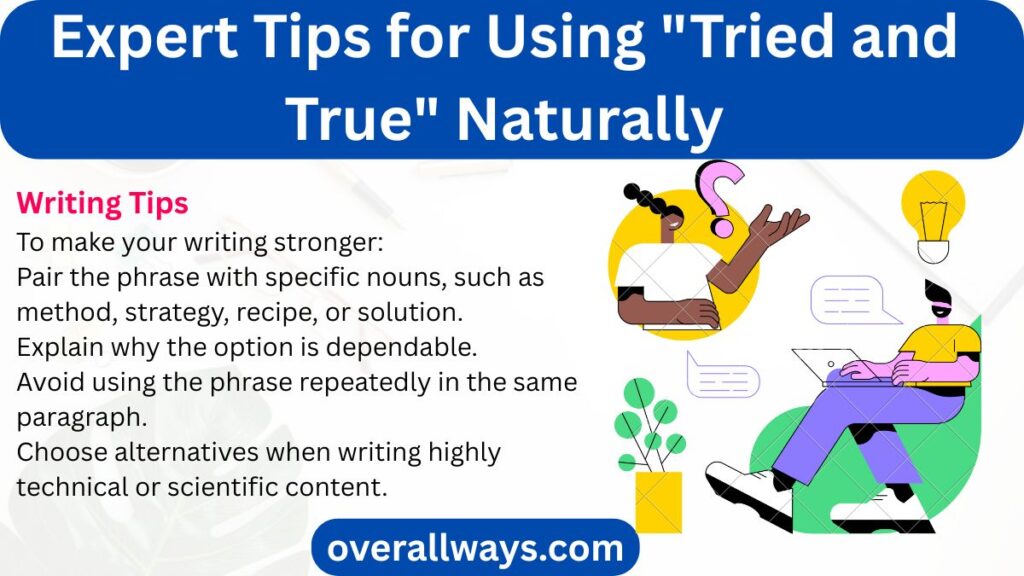
Native speakers often use this expression in recommendations, reviews, and advice because it creates a sense of confidence.
Writing Tips
To make your writing stronger:
- Pair the phrase with specific nouns, such as method, strategy, recipe, or solution.
- Explain why the option is dependable.
- Avoid using the phrase repeatedly in the same paragraph.
- Choose alternatives when writing highly technical or scientific content.
Example:
Our tried and true customer support process has consistently delivered excellent satisfaction ratings over the past decade.
Speaking Tips
In conversation, the phrase often appears when people recommend something they trust.
Examples:
- “I’d stick with the tried and true option.”
- “It’s a tried and true way to learn English.”
- “That’s a tried and true recipe.”
Using it naturally can make your English sound more fluent and confident.
Choosing the Right Context
The phrase works especially well in:
- Product recommendations
- Customer reviews
- Workplace discussions
- Blog posts
- Presentations
- Everyday conversations
- Business meetings
It is less common in legal documents or highly technical scientific papers.
Quick Comparison Table
| Expression | Meaning | Best Used In |
|---|---|---|
| Tried and True | Proven reliable through experience | Everyday English, business, blogs |
| Tried and Tested | Proven after repeated testing | British English |
| Proven | Supported by evidence or success | Business, science |
| Reliable | Dependable and consistent | General English |
| Time-Tested | Effective for many years | Formal writing |
| Established | Widely accepted and trusted | Academic and professional writing |
Frequently Asked Questions
What does tried and true mean?
Tried and true means something has been tested over time and has consistently proven to be reliable, effective, and trustworthy. It often describes methods, products, services, strategies, or advice with a strong history of success.
Is tried and true an idiom?
Yes. It is widely recognized as an English idiom or fixed expression. While the individual words have literal meanings, together they express the idea of proven reliability through repeated success.
How do you use tried and true in a sentence?
Here are a few examples:
- This is a tried and true method for improving writing skills.
- We rely on a tried and true customer service process.
- Her grandmother’s pie recipe is tried and true.
What is another word for tried and true?
Common synonyms include:
- Proven
- Reliable
- Dependable
- Trustworthy
- Established
- Time-tested
- Well-tested
- Field-tested
- Battle-tested
Each word shares a similar meaning but may suit different contexts.
What is the opposite of tried and true?
Common antonyms include:
- Untested
- Unproven
- Experimental
- Unreliable
- Inconsistent
- Unverified
- Risky
These words describe ideas or products that have not yet demonstrated dependable results.
Where did the phrase tried and true come from?
The expression has been part of English for centuries. Historically, “tried” meant tested, while “true” referred to loyalty and dependability. Over time, the phrase evolved to describe anything that has earned trust through repeated success.
Is tried and true the same as tried and tested?
They have nearly identical meanings. The main difference is regional preference:
- Tried and true is more common in American English.
- Tried and tested is more common in British English.
Both refer to something that has been successfully tested and proven reliable.
Can tried and true describe people?
Yes. Although it more commonly describes methods or products, it can also describe people who are dependable, experienced, and trustworthy.
Example:
She is a tried and true leader who has guided the company through many challenges.
Can tried and true describe products?
Absolutely. Businesses often use the phrase to describe products with a long history of customer satisfaction and consistent performance.
Example:
This laptop remains a tried and true choice for professionals.
Is tried and true formal or informal?
The phrase works well in both everyday conversation and professional writing. However, in highly technical or academic contexts, terms such as validated, evidence-based, or established may be more appropriate.
What does tried and true mean in business?
In business, tried and true refers to strategies, processes, or systems that have consistently produced successful outcomes. Companies often use the phrase to highlight reliability, efficiency, and a proven history of delivering results.
What does tried and true mean in everyday English?
In everyday English, it simply means something that people trust because it has worked well many times before. It often appears when giving recommendations about recipes, products, services, study habits, or practical advice.
Conclusion
Understanding the Tried and True Meaning is about more than memorizing a definition. It’s about recognizing why English speakers value experience, consistency, and reliability. Whether you’re describing a proven method, a trusted approach, a reliable solution, or a time-tested technique, this expression communicates confidence built through real-world success.
From casual conversations to business presentations, tried and true remains one of the most useful and enduring phrases in the English language. By learning its meaning, origin, grammar patterns, and practical applications, you can use it naturally and accurately in both spoken and written English.
The next time you recommend a dependable product, a successful strategy, or a method that has consistently delivered results, you’ll know exactly why calling it tried and true is the perfect choice.
You have not enough Humanizer words left. Upgrade your Surfer plan.

Hi, I’m Oliver Grant. I write about word meanings, slang terms, acronyms, and communication tips. Through Overall Ways, I help readers learn new words, understand modern language trends, and communicate more effectively.
