
Have you ever received a message that simply says “CYA!” and wondered what it meant? You’re not alone. Texting abbreviations evolve quickly, and the same acronym can carry different meanings depending on the conversation.
In most casual conversations, CYA means “See Ya,” which is a friendly and informal way of saying goodbye. However, in professional settings, the same acronym often stands for “Cover Your Ass,” a workplace expression that refers to protecting yourself from blame by documenting actions or following procedures.
Understanding the difference matters because using the wrong interpretation can lead to awkward conversations or misunderstandings. This guide explains the What Does CYA Mean in message question in depth, shows real examples, explores how people use it across different platforms, and helps you know when it’s appropriate to use.
Whether you saw CYA in a message message, on Snapchat, Instagram, TikTok, Discord, or at work, you’ll find the answer here.
Key Takeaways
Here’s a quick summary of everything covered in this guide.
- What Does CYA Mean in message? Most commonly, it means “See Ya.”
- In professional settings, CYA can also mean “Cover Your Ass.”
- Context is the easiest way to determine the intended meaning.
- Friends, family, and gamers typically use the goodbye meaning.
- Workplace discussions often use the documentation meaning.
- Avoid using the workplace version in formal communication.
- When you’re unsure, writing “See you later” is always a safe choice.
- Understanding texting abbreviations, internet slang, and online messaging terms makes digital conversations easier to follow.
Quick Answer: What Does CYA Mean in message?
Featured Snippet Answer:
What Does CYA Mean in Text? In most text messages, CYA means “See Ya,” an informal way to say goodbye. In workplace conversations, CYA can also mean “Cover Your Ass,” which refers to protecting yourself by keeping records, following procedures, or documenting decisions. The correct meaning depends entirely on the context of the conversation.
Here’s a quick overview.
| Term | Meaning | Common Usage | Tone |
|---|---|---|---|
| CYA | See Ya | Friends, family, texting | Friendly |
| CYA | Cover Your Ass | Workplace, business | Informal, professional slang |
Most people who search for What Does CYA Mean in message are looking for the first meaning because it’s widely used in casual conversations.
What Does CYA Stand For?
The CYA abbreviation has two widely recognized meanings. Although they share the same letters, they serve completely different purposes.
CYA = “See Ya”
The most common CYA message meaning is “See Ya.”
“See Ya” is simply a shortened version of “See you later.” It’s one of many texting abbreviations people use to save time while keeping conversations casual.
You’ll often see it at the end of conversations, much like:
- Bye
- Later
- Catch you later
- Talk soon
- See you
For example:
Friend: I’m heading home now.
You: Sounds good. CYA!
In this example, the message is warm, friendly, and casual.
People commonly use this version in:
- Text messages
- WhatsApp chats
- Instagram DMs
- Snapchat
- Facebook Messenger
- Discord
- Gaming chats
Because it’s short and easy to type, CYA in texting remains popular even though smartphones now offer predictive message.
CYA = “Cover Your Ass”
The second CYA acronym has a very different meaning.
In business and workplace communication, CYA often means “Cover Your Ass.”
Although the phrase contains profanity, people usually use it to describe protecting themselves by keeping written records, documenting conversations, or following company procedures.
For example:
“Make sure you save every email. It’s just good CYA.”
This doesn’t mean someone expects trouble. Instead, it highlights the importance of accountability and documentation.
Common situations include:
- Saving emails
- Keeping meeting notes
- Recording approvals
- Documenting project decisions
- Following compliance procedures
Many professionals use the phrase informally, although it’s generally inappropriate in formal business documents or communications with clients.
Why Does One Acronym Have Two Meanings?
This happens frequently with internet abbreviations.
Language changes quickly, especially online. Many abbreviations develop multiple meanings over time.
For CYA, context makes everything clear.
Consider these examples.
Example 1
Thanks for hanging out today. CYA tomorrow!
Clearly means:
See Ya.
Example 2
Keep copies of every contract. That’s basic CYA.
Clearly means:
Cover Your Ass.
The surrounding conversation removes any confusion.
How to Tell Which Meaning Someone Intended
One reason people search for the meaning of CYA is that both definitions appear online.
Fortunately, it’s usually easy to determine the intended meaning by looking at the conversation.
Look at the Topic
Ask yourself:
What are people discussing?
If they’re talking about meeting up, saying goodbye, or ending a chat, CYA almost always means:
See Ya.
If they’re discussing work, documentation, legal matters, deadlines, or responsibility, it likely means:
Cover Your Ass.
Consider the Relationship
Think about who sent the message.
A close friend texting:
CYA tonight!
is obviously saying goodbye.
A manager writing:
Keep detailed notes for CYA.
almost certainly means protecting yourself professionally.
Relationships provide valuable context.
Pay Attention to Tone
Tone matters just as much as the words.
Friendly emojis 😊
Casual jokes 😂
Weekend plans 🎉
These all suggest:
See Ya.
Meanwhile, discussions about:
- reports
- documentation
- policies
- audits
- contracts
usually indicate the workplace meaning.
Notice the Platform
Different platforms encourage different styles of communication.
| Platform | Most Likely Meaning |
|---|---|
| SMS | See Ya |
| See Ya | |
| Snapchat | See Ya |
| See Ya | |
| TikTok comments | See Ya |
| Discord | Depends on context |
| Slack | Either meaning |
| Microsoft Teams | Often Cover Your Ass |
| Workplace email | Usually Cover Your Ass |
This isn’t a strict rule, yet it’s a useful guideline.
CYA Meaning With Examples
Nothing explains CYA slang better than real conversations.
Here are practical examples that show how native English speakers naturally use it.
Casual Text Between Friends
Emma
Movie starts at 8.
Jake
I’ll be there.
Emma
Awesome. CYA!
Meaning:
See Ya.
Family Conversation
Mom
Dinner’s ready.
Son
Leaving work now.
Mom
Great. CYA soon.
Again, it simply means:
See you soon.
Nice. CYA tomorrow.
Meaning:
See you tomorrow.
Gaming Chat
Many online games encourage fast communication.
Players often write:
GG everyone.
CYA tomorrow.
Here, GG means “Good Game,” while CYA means “See Ya.”
Workplace Example
Manager:
Please upload today’s report before leaving.
Employee:
Done.
Manager:
Perfect. That helps with our CYA documentation.
This refers to keeping records rather than saying goodbye.
Email Discussion
Coworker:
Should I save all approval emails?
Supervisor:
Definitely. Always practice good CYA.
Again, this means maintaining documentation.
you may like
- What Does SYBAU Mean in Text? Complete Guide to Its Meaning, Usage, and Contexts
- What Does “IYKYK” Mean in Text? Complete Guide to Its Meaning, Usage, and Contexts
- What Do “TS” Mean in Text? Complete Guide to Its Meanings Across Contexts
When People Commonly Use CYA in Messages
The CYA messaging slang appears in many everyday situations.
Some of the most common include:
- Ending conversations
- Leaving group chats
- Saying goodbye after gaming
- Ending video calls
- Leaving social media conversations
- Wrapping up text messages
- Signing off after making plans
You’ll also encounter the professional version during:
- Project management
- Human resources discussions
- Legal compliance
- Corporate meetings
- Risk management
- Documentation procedures
The same three letters serve two completely different purposes depending on the environment.
Why Is CYA So Popular?
Modern digital communication favors speed.
People naturally shorten words while texting because it’s faster and feels more conversational.
Instead of typing:
See you later.
Many simply type:
CYA
The abbreviation is:
- easy to remember
- quick to type
- widely understood
- friendly
- informal
That’s why it continues to appear across online messaging terms, social media communication, and mobile messaging apps.
Common Variations Related to CYA
You’ll often see CYA alongside other farewell expressions.
| Phrase | Meaning | Formality |
|---|---|---|
| CYA | See Ya | Informal |
| CU | See You | Informal |
| TTYL | Talk To You Later | Informal |
| GTG | Got To Go | Informal |
| Later | Goodbye | Informal |
| Catch you later | Goodbye | Casual |
| Bye | Goodbye | Neutral |
| See you soon | Farewell | Neutral |
Although these phrases share similar meanings, each creates a slightly different tone.
For instance:
- Bye feels universal.
- TTYL suggests another conversation later.
- Catch you later sounds relaxed.
- CYA feels quick and friendly.
Choosing the right one depends on your relationship with the other person and the situation.
Expert Insight: Context Always Comes First
One of the biggest mistakes people make is assuming every acronym has only one definition.
That isn’t how language works.
Many chat abbreviations, internet slang words, and online abbreviations have multiple meanings that depend on context.
For example:
- LOL originally meant “Laugh Out Loud,” yet some people now use it simply to soften a sentence.
- DM can mean “Direct Message” or “Dungeon Master,” depending on the conversation.
- CYA follows the same pattern.
Whenever you’re unsure, don’t focus only on the letters. Read the surrounding messages, consider who sent them, and think about the topic being discussed. In almost every case, the intended meaning becomes obvious.
What Does CYA Mean in Social Media?
While CYA started as a simple texting abbreviation, it’s now common across nearly every major social media platform. The meaning usually stays the same, although the context can change based on how people communicate on each platform.
If you’re wondering what does CYA mean in social media, the answer is straightforward:
- In most posts, comments, and direct messages, CYA means “See Ya.”
- In professional communities or business discussions, it can mean “Cover Your Ass.”
Let’s look at how people use it across popular platforms.
CYA in WhatsApp
The CYA in WhatsApp meaning is almost always “See Ya.”
People use it when ending a conversation, leaving a group chat, or confirming plans.
Example:
Sarah: I’ll text you tomorrow.
Mike: Sounds good. CYA!
It creates a friendly, informal ending without typing a full sentence.
What Does CYA Mean on Snapchat?
If you’ve searched what does CYA mean on Snapchat, you’re likely seeing the casual version.
Snapchat conversations are short and fast, making abbreviations very common.
Examples include:
- CYA
- BRB
- TTYL
- LOL
- LMK
Example Snap Chat
Friend:
Heading out now.
You:
Okay, CYA later!
There’s no hidden meaning here. It’s simply another way to say goodbye.
What Does CYA Mean on Instagram?
The CYA on Instagram meaning doesn’t change much.
You’ll see it in:
- Direct Messages
- Story replies
- Comments
- Live chats
Example:
Great talking with you. CYA soon!
Because Instagram encourages casual conversations, the goodbye meaning is by far the most common.
What Does CYA Mean on TikTok?
People often ask what does CYA mean on TikTok because comment sections move quickly.
TikTok users frequently shorten common phrases.
Example:
I’m logging off.
CYA tomorrow!
You’ll also find creators saying:
Thanks for watching. CYA next video!
Again, it simply means:
See you next time.
CYA on Facebook
Facebook combines personal conversations with professional networking.
That means CYA on Facebook can have either meaning.
Examples:
Personal:
Had fun today. CYA!
Professional group:
Keep written approvals for CYA purposes.
Always read the surrounding discussion before deciding which interpretation fits.
CYA in Discord
Discord serves gamers, students, developers, and business communities.
Because of that, CYA in Discord depends heavily on the server.
Gaming server:
Good match everyone.
CYA tomorrow!
Work server:
Save your deployment notes for CYA.
Discord is one platform where context matters more than anywhere else.
Why CYA in Texting Remains Popular
Language evolves alongside technology.
As messaging became faster, people naturally shortened common expressions.
Today, CYA message abbreviation survives because it’s:
- Easy to type
- Easy to recognize
- Friendly
- Informal
- Widely understood
Unlike some older abbreviations that have disappeared, CYA still feels natural because people regularly end conversations.
Whether you’re using SMS, WhatsApp, Messenger, or Discord, saying goodbye happens every day.
What Does CYA Mean in Professional Communication?
Many people are surprised to learn that CYA has an entirely different meaning at work.
Instead of saying goodbye, it often refers to reducing professional risk.
Understanding “Cover Your Ass”
In business, CYA means taking reasonable steps to protect yourself if questions arise later.
That may include:
- Saving important emails
- Confirming verbal instructions in writing
- Documenting meetings
- Keeping approval records
- Following company procedures
The goal isn’t to avoid responsibility.
Instead, it’s to create transparency and accountability.
Why Documentation Matters
Imagine two employees receive different verbal instructions.
Months later, nobody remembers exactly what happened.
The employee who documented the discussion can easily clarify the situation.
That’s why experienced managers often encourage employees to:
- Keep project records.
- Save approval emails.
- Document important decisions.
These habits help entire organizations, not just individuals.
A Real-World Workplace Example
Suppose a project manager receives approval to delay a product launch.
Instead of relying on memory, the manager sends a follow-up email:
Thanks for approving the revised launch date.
That email becomes documentation.
Later, if questions arise, everyone has the same written record.
This represents practical CYA without creating conflict.
Is CYA Rude or Offensive?
One of Google’s most common questions is:
Is CYA rude or polite?
The answer depends entirely on which meaning you’re using.
When CYA Means “See Ya”
This version isn’t rude.
It’s simply an informal goodbye.
Friends use it every day.
Examples:
- CYA tomorrow!
- CYA after work.
- CYA tonight.
- CYA soon.
The tone is relaxed and friendly.
When CYA Means “Cover Your Ass”
This version contains implied profanity because of the original phrase.
Although professionals often shorten it to CYA, some people still find it inappropriate.
It’s generally acceptable among coworkers who know each other well.
However, avoid using it in:
- Client emails
- Job interviews
- Academic papers
- Official reports
- Customer service messages
In formal communication, choose clearer alternatives.
Better Professional Alternatives
Instead of saying:
We need good CYA.
Consider saying:
- Let’s document everything carefully.
- Keep written records.
- Record all approvals.
- Maintain proper documentation.
- Follow compliance procedures.
These alternatives sound professional while communicating the same idea.
How to Respond When Someone Says CYA
Your response depends on which meaning they intended.
Replies to “See Ya”
If someone is saying goodbye, you can reply with:
- See you!
- Bye!
- Catch you later!
- Later!
- Take care!
- Have a great day!
- See you tomorrow!
- Talk soon!
These responses feel natural and friendly.
Replies to Workplace CYA
When someone uses the workplace meaning, they’re usually discussing documentation.
Appropriate responses include:
- I’ll save the emails.
- Good idea.
- I’ll document everything.
- I’ll keep a record.
- Thanks for the reminder.
Notice that none of these repeat the slang.
Professional communication benefits from clarity.
CYA vs. Other Common Texting Abbreviations
Many people learning texting vocabulary confuse similar abbreviations.
Here’s a practical comparison.
| Abbreviation | Meaning | Typical Use | Formal? |
|---|---|---|---|
| CYA | See Ya / Cover Your Ass | Goodbye or workplace slang | Casual |
| TTYL | Talk To You Later | Ending conversations | Casual |
| BRB | Be Right Back | Short break | Casual |
| GTG | Got To Go | Leaving chat | Casual |
| CU | See You | Goodbye | Casual |
| FYI | For Your Information | Sharing information | Neutral |
| IMO | In My Opinion | Giving opinions | Casual |
| IDK | I Don’t Know | Responding to questions | Casual |
| LMK | Let Me Know | Asking for updates | Neutral |
| OMW | On My Way | Travel updates | Casual |
Understanding these abbreviations makes online conversations much easier.
you may like
- What Does “RT” Mean in Text? A Complete Guide to Its Usage and Contexts
- UwU Meaning in Text: The Complete Guide to This Internet Slang Term
- What Does WWA Mean in Text? Complete Guide to Its Meanings and Uses
- What Does “DC” Mean in Text? Complete Guide to Its Uses Across Chat, Social Media, and More
Common Misunderstandings About CYA
Although CYA looks simple, misunderstandings happen regularly.
Here are the most common ones.
Assuming It Always Means “See Ya”
Many people have never heard the workplace definition.
As a result, they become confused during office conversations.
Always consider the topic first.
Assuming It Always Means “Cover Your Ass”
This mistake happens too.
Someone receives:
CYA tomorrow!
Then they wonder why the message seems strange.
In reality, it’s simply a friendly goodbye.
Ignoring Context
Context solves nearly every misunderstanding.
Ask yourself:
- Who sent the message?
- What were they discussing?
- Where was it posted?
- Does the conversation involve work?
These questions usually reveal the correct meaning immediately.
Best Practices for Using CYA
Using CYA correctly isn’t difficult, yet a few simple habits can prevent confusion.
Know Your Audience
Friends understand casual slang.
Clients may not.
Adjust your language accordingly.
Match the Conversation
Casual text?
Use:
CYA!
Formal email?
Avoid slang.
Instead write:
See you tomorrow.
or
Looking forward to speaking again.
Don’t Force Abbreviations
Some people overuse internet slang words because they’re popular.
Clear communication should always come first.
If writing the complete phrase improves understanding, choose clarity over brevity.
Keep Workplace Communication Professional
Although coworkers may casually say CYA, official communication should remain professional.
Documentation should always speak for itself.
Expert Tips for Using CYA Naturally
People who communicate well don’t memorize slang. They understand when each expression fits naturally.
Here are a few practical tips.
Use “CYA” only with people who are comfortable with casual texting.
Avoid workplace slang in customer-facing communication.
If there’s any chance of confusion, write “See you” instead.
Remember that context matters more than the abbreviation itself.
Following these simple guidelines helps your messages sound friendly, clear, and appropriate regardless of the platform.
Common Mistakes to Avoid
Even native English speakers occasionally misuse texting abbreviations. Avoid these common errors when using CYA.
- Using CYA in formal emails. Business communication should prioritize clarity over slang.
- Assuming everyone knows both meanings. Many people only recognize “See Ya.”
- Ignoring context. Always consider the conversation before interpreting the acronym.
- Overusing abbreviations. Too much texting slang can make messages harder to read.
- Using workplace CYA with clients. The implied profanity can appear unprofessional, even when abbreviated.
A good rule of thumb is simple: if there’s any doubt, write out the full phrase instead.
Real-World Examples of CYA Meaning in message
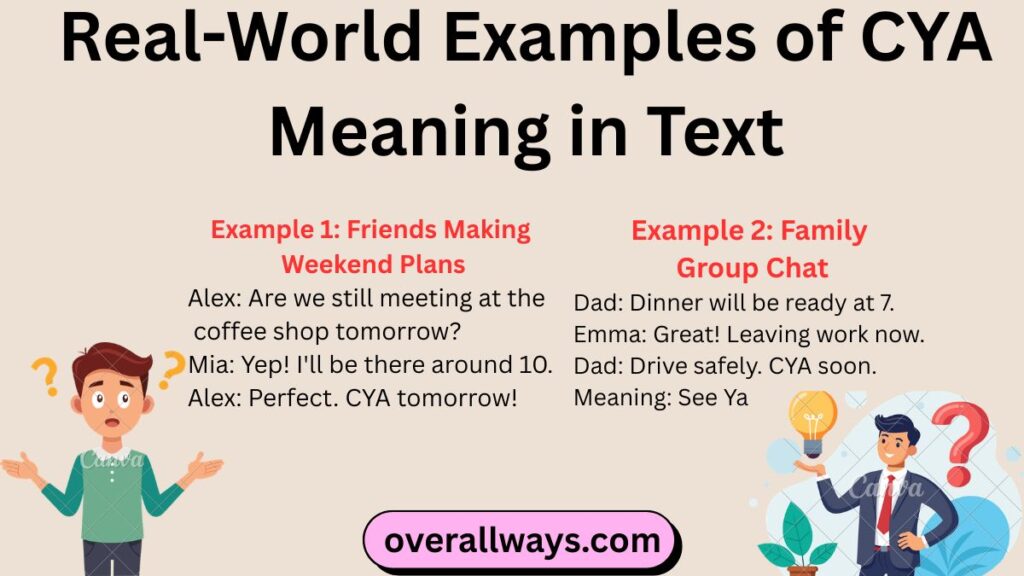
Reading definitions is helpful, but seeing CYA in real conversations makes the meaning much easier to understand. The examples below reflect situations you might encounter in everyday digital communication, whether you’re texting a friend or chatting with coworkers.
Example 1: Friends Making Weekend Plans
Alex: Are we still meeting at the coffee shop tomorrow?
Mia: Yep! I’ll be there around 10.
Alex: Perfect. CYA tomorrow!
Meaning: See Ya
This is the most common CYA meaning in texting. It’s simply a casual goodbye.
Example 2: Family Group Chat
Dad: Dinner will be ready at 7.
Emma: Great! Leaving work now.
Dad: Drive safely. CYA soon.
Meaning: See Ya
The phrase creates a warm, natural ending to the conversation.
Example 4: Workplace Conversation
Project Manager: Please upload the signed contract before the meeting.
Employee: Done.
Manager: Thanks. That’s good CYA.
Meaning: Cover Your Ass
Here, the manager is referring to proper documentation rather than saying goodbye.
Example 5: Office Email Follow-Up
Supervisor: Please summarize today’s meeting and email everyone.
Employee: I’ll send it this afternoon.
Supervisor: Excellent. It provides good CYA if questions come up later.
Again, the phrase refers to keeping accurate records.
Case Study: One Acronym, Two Completely Different Meanings
Imagine two people receiving the exact same message:
“CYA tomorrow!”
Situation One
The message comes from a college friend after making lunch plans.
The meaning is obvious:
See Ya tomorrow.
Situation Two
The message appears in a project management discussion:
Make sure everything is documented. Good CYA tomorrow before the audit.
Now the meaning changes completely.
It refers to documenting work before an audit.
Lesson
The letters never change.
The context changes everything.
This simple example shows why understanding online messaging slang requires more than memorizing abbreviations. You also need to understand the conversation itself.
CYA vs. “See You Later”
Many readers also search for CYA vs see you later.
Although the phrases have similar meanings, they aren’t identical.
| Phrase | Tone | Best Used In |
|---|---|---|
| CYA | Casual | Friends, texting, gaming |
| See you later | Casual to neutral | Most conversations |
| Catch you later | Relaxed | Friends |
| Talk to you later | Friendly | Texting and phone calls |
| Goodbye | Neutral | Personal and professional conversations |
| Farewell | Formal | Speeches, letters, official settings |
If you’re unsure which phrase to use, “See you later” works in almost every casual situation. CYA is best reserved for informal chats where abbreviations feel natural.
Common Mistakes When Interpreting CYA
Even experienced English speakers occasionally misunderstand internet slang. Here are a few mistakes to avoid.
Assuming It Has Only One Meaning
Many people believe CYA always means “See Ya.” Others think it always refers to workplace documentation.
Both assumptions are incorrect.
Always consider the surrounding conversation.
Forgetting Your Audience
Using CYA with close friends is completely normal.
Using it in a formal presentation or a message to a new client may create confusion or appear too informal.
Know who you’re talking to before using slang.
Confusing It with Similar Abbreviations
Some people mix CYA with other common message abbreviations.
Here’s a quick comparison.
| Abbreviation | Meaning |
|---|---|
| CYA | See Ya / Cover Your Ass |
| TTYL | Talk To You Later |
| BRB | Be Right Back |
| LOL | Laugh Out Loud |
| LMK | Let Me Know |
| FYI | For Your Information |
| IMO | In My Opinion |
| IDK | I Don’t Know |
| SMH | Shaking My Head |
| WYD | What Are You Doing? |
Learning these common abbreviations makes modern online conversation much easier to understand.
Best Practices for Using CYA
If you want your messages to sound natural, follow these practical tips.
Use It in Informal Conversations
The goodbye meaning works best with:
- Friends
- Family
- Classmates
- Gaming communities
- Social media conversations
Avoid It in Formal Writing
Business reports, academic papers, and official emails should avoid unnecessary slang.
Instead of writing:
CYA tomorrow.
Write:
See you tomorrow.
The message feels more professional while remaining friendly.
Let Context Do the Work
One of the strengths of internet slang is efficiency.
Don’t overexplain.
If everyone already understands the conversation, CYA works perfectly.
When in Doubt, Spell It Out
If you’re unsure whether the other person knows the abbreviation, simply write:
See you later.
Clear communication always beats clever shortcuts.
Expert Tips for Understanding Texting Slang
People often focus on memorizing abbreviations, but fluent communication comes from understanding how people actually use them.
Here are a few practical tips.
Learn Groups of Related Terms
Instead of learning CYA by itself, learn similar expressions together.
For example:
- See ya
- Catch you later
- TTYL
- GTG
- Bye
- Later
This approach builds natural texting vocabulary.
Watch for Tone
Slang often reflects emotion.
A message ending with:
CYA 😊
feels warm and friendly.
A workplace discussion mentioning:
CYA documentation
has an entirely different tone.
Always read the complete conversation.
Don’t Overuse Slang
Native English speakers mix abbreviations with full sentences.
Instead of filling every message with shorthand, use abbreviations naturally.
That keeps conversations clear and enjoyable.
Frequently Asked Questions
What Does CYA Mean in chat Messages?
In most chat messages, CYA means “See Ya.” It’s an informal way to say goodbye or let someone know you’ll see them later.
What Does CYA Stand for in Texting?
The CYA full form is usually “See Ya.”
In workplace communication, it can also stand for “Cover Your Ass.”
The intended meaning depends on the conversation.
What Does CYA Mean on Snapchat?
On Snapchat, CYA almost always means “See Ya.”
People use it when ending chats or saying goodbye after sharing photos or messages.
What Does CYA Mean on Instagram?
The CYA on Instagram meaning is generally the same as texting.
Users commonly write it in direct messages, comments, or story replies to mean “See Ya.”
What Does CYA Mean on TikTok?
On TikTok, creators and viewers often use CYA to mean:
- See you later
- See you next time
- Goodbye
You’ll frequently see it in comments or at the end of videos.
Is CYA Rude?
No.
When it means “See Ya,” it’s simply casual and friendly.
The workplace meaning includes an implied profanity, so it’s best avoided in formal business communication.
Can You Use CYA in Professional Emails?
Generally, no.
While coworkers may casually say CYA when discussing documentation, writing the full message is usually more appropriate in professional emails.
Why Does CYA Have Two Meanings?
Many internet abbreviations and chat terms develop multiple meanings over time.
Context determines which interpretation applies.
This is common in modern online language and digital slang.
How Do You Use CYA in a Sentence?
Here are a few examples.
- CYA after class!
- Thanks for hanging out. CYA soon!
- Keep copies of every agreement for CYA purposes.
The first two mean See Ya.
The third refers to workplace documentation.
Is CYA Still Popular?
Yes.
Although language continues to evolve, CYA remains one of the most recognized chat message abbreviations because it’s short, memorable, and easy to understand.
Conclusion
Now you have a complete understanding of What Does “CYA” Mean in chat and why this small abbreviation can carry two very different meanings.
In everyday chat messages, social media chats, and online conversations, CYA almost always means “See Ya,” making it a friendly and informal way to say goodbye. In contrast, business professionals sometimes use CYA as shorthand for “Cover Your Ass,” referring to the practice of documenting work and following procedures to reduce misunderstandings and protect accountability.
The key is to focus on context rather than the letters themselves. Consider who sent the message, where the conversation is taking place, and what everyone is discussing. Those clues almost always reveal the correct meaning.
As digital communication continues to evolve, abbreviations like CYA, LOL, BRB, TTYL, FYI, LMK, and IDK remain an important part of modern online language. Learning how they’re used naturally will help you communicate with greater confidence across text messages, social media platforms, and professional environments alike.

Hi, I’m Oliver Grant. I write about word meanings, slang terms, acronyms, and communication tips. Through Overall Ways, I help readers learn new words, understand modern language trends, and communicate more effectively.
