
Have you ever wondered what does OPEL mean? Is it an acronym? Does it have a hidden definition? Or is it simply the name of a famous car company?
The short answer is simple: OPEL is not an acronym or abbreviation. Instead, the name comes from Adam Opel, the German entrepreneur who founded the company in 1862. What began as a small sewing machine business eventually became one of Europe’s most respected automobile manufacturers.
Today, the Opel brand stands for German engineering, practical design, affordable innovation, and more than 160 years of industrial heritage. The company has survived economic crises, world wars, ownership changes, and rapid advances in automotive technology. It now operates under Stellantis, one of the world’s largest automotive groups.
In this guide, you’ll learn the complete OPEL meaning, the fascinating history behind the name, the company’s evolution from sewing machines to electric vehicles, and why Opel continues to play an important role in the European automotive industry.
Key Takeaways
If you remember only a few points from this guide, make them these:
- OPEL is the surname of Adam Opel, not an acronym.
- The company was founded in 1862 in Rüsselsheim, Germany.
- Opel began by manufacturing sewing machines before expanding into bicycles and automobiles.
- The famous lightning bolt logo symbolizes speed, innovation, and engineering excellence.
- Opel is now part of Stellantis, while maintaining its German identity.
- The company continues developing modern passenger cars, SUVs, commercial vehicles, and electric vehicles.
- Opel’s greatest strength has always been delivering practical engineering to everyday drivers.
What Does OPEL Meaning Actually Mean?
The Quick Answer
If you’re looking for a simple explanation, here’s the answer:
OPEL is the surname of the company’s founder, Adam Opel. It does not stand for a phrase, acronym, or abbreviation.
Many people search for terms like:
- what does OPEL mean
- OPEL full meaning
- OPEL definition
- OPEL acronym
- OPEL abbreviation
- OPEL stands for
These searches often lead to confusion because many well-known automotive brands use initials or abbreviations. Opel does not.
Instead, the company proudly carries the family name of its founder, making it one of the oldest continuously recognized automotive brand names in Europe.
Featured Snippet Answer
What does OPEL mean?
OPEL is the family name of Adam Opel, who founded the company in Germany in 1862. The name does not represent an acronym or abbreviation. It identifies one of Germany’s oldest and most influential automobile manufacturers.
Is OPEL an Acronym?
No.
Despite frequent online searches for an OPEL acronym or OPEL abbreviation, there has never been an official expansion of the word.
Unlike brands such as BMW (Bayerische Motoren Werke) or FIAT (Fabbrica Italiana Automobili Torino), Opel is simply a surname.
Here’s a quick comparison.
| Brand | Meaning |
|---|---|
| Opel | Founder’s family name |
| BMW | Bayerische Motoren Werke |
| FIAT | Fabbrica Italiana Automobili Torino |
| SAAB | Svenska Aeroplan Aktiebolaget |
| Audi | Latin translation of founder August Horch’s surname |
This distinction explains why searches for an OPEL full meaning often produce misleading answers on unofficial websites.
The OPEL Name Meaning in Simple Words
The meaning of OPEL isn’t hidden inside the letters themselves.
Instead, the value of the name comes from what it represents.
Today, the Opel name meaning has become associated with:
- German engineering
- Reliable family vehicles
- Affordable innovation
- European manufacturing
- Practical transportation
- Automotive excellence
- Industrial heritage
Over more than a century, the surname “Opel” transformed into a globally recognized automotive identity.
That transformation didn’t happen overnight. It took decades of innovation, careful engineering, and smart business decisions.
Who Was Adam Opel?
Understanding who founded Opel helps explain why the company remains so respected today.
Early Life of Adam Opel
Adam Opel was born on May 9, 1837, in Rüsselsheim, in what is now Germany.
His father worked as a locksmith, exposing Adam to mechanical craftsmanship from an early age. Like many skilled workers during the Industrial Revolution, Adam traveled across Europe to learn advanced manufacturing techniques.
During his travels, he spent time in France, where he became interested in sewing machine production. At that time, sewing machines represented one of the world’s fastest-growing technologies.
Instead of entering the transportation industry immediately, Adam returned home with a different vision.
He wanted to manufacture sewing machines.
That decision laid the foundation for what would eventually become one of Europe’s best-known automotive companies.
Adam Opel Biography: The Entrepreneur Behind the Brand
Several qualities distinguished Adam Opel from many industrialists of his era.
He believed in:
- Precision engineering
- Continuous improvement
- High manufacturing standards
- Product reliability
- Affordable quality
Those same principles still influence the Opel company today.
Rather than chasing luxury, Adam focused on creating dependable products for ordinary people. That philosophy later shaped Opel’s approach to automobile manufacturing.
Why the Company Bears His Name
During the nineteenth century, family-owned businesses commonly carried the founder’s surname.
Examples include:
- Ford
- Peugeot
- Renault
- Benz
- Ferrari
- Opel
Using the founder’s name built trust.
Customers knew exactly who stood behind the product. Every machine represented the founder’s reputation.
Over time, the Opel surname became more than a family name. It evolved into a trusted international brand.
The Origin of the Opel Brand
The origin of Opel begins decades before the company built its first automobile.
Many people assume Opel has always manufactured cars.
That’s not true.
Its history reflects one of the most fascinating business transformations in European industrial history.
From Sewing Machines to Industrial Success
In 1862, Adam Opel established a workshop in Rüsselsheim dedicated to manufacturing sewing machines.
The timing proved ideal.
Demand for mechanized sewing equipment was growing rapidly across Europe.
Within years, the business expanded significantly.
The company earned a reputation for producing reliable machines at competitive prices.
This success provided the financial stability that later allowed the company to diversify.
Today, historians often view this period as the true beginning of the Opel company history.
Entering the Bicycle Industry
During the 1880s, bicycles emerged as a revolutionary form of personal transportation.
Adam Opel recognized another opportunity.
The company began producing bicycles using the same manufacturing principles that had made its sewing machines successful.
This move transformed the business.
By the late nineteenth century, Opel had become one of the world’s largest bicycle manufacturers.
Its racing bicycles achieved remarkable success in European competitions, strengthening the company’s reputation for engineering excellence.
The bicycle era also taught Opel valuable lessons about:
- Lightweight construction
- Mechanical efficiency
- Mass production
- Product durability
- Customer demand
Those lessons later influenced automobile development.
The Beginning of Automobile Manufacturing
Ironically, Adam Opel never witnessed the company’s success in automobiles.
He passed away in 1895.
After his death, his wife Sophie Opel and their sons decided to expand into the rapidly growing automobile market.
In 1899, Opel produced its first automobile after acquiring the motor vehicle business of Friedrich Lutzmann.
This milestone marked the beginning of Opel’s automotive journey.
It also changed the company’s future forever.
Also like
HB Meaning Explained: Full Guide, Uses, and Real-Life Contexts (2026)
BTA Meaning Explained: The Real Definition, Uses & Online Contexts in 2026
What Does “JP” Mean in Text? A Complete Guide to Its Uses and Interpretations
FS Meaning: What Does FS Mean in a Text? The Complete Guide to Every Definition and Use Case
How Opel Became a Leading German Car Manufacturer
The early automotive industry evolved quickly.
Hundreds of manufacturers appeared across Europe.
Only a handful survived.
Opel became successful because it focused on making practical vehicles rather than experimental luxury machines.
The company emphasized:
- Efficient production
- Affordable pricing
- Dependable engineering
- Broad customer appeal
These priorities helped Opel grow rapidly during the early twentieth century.
Mass Production Changed Everything
A major turning point arrived during the 1920s.
Opel adopted advanced assembly-line manufacturing techniques similar to those pioneered in the United States.
This innovation dramatically reduced production costs.
Lower costs meant lower prices.
Lower prices meant more customers.
As vehicle ownership expanded across Europe, Opel became one of Germany’s largest automobile producers.
Opel’s Engineering Philosophy
Throughout its history, Opel engineering has emphasized balance.
Rather than chasing extreme performance, the company focuses on:
- Safety
- Reliability
- Practicality
- Fuel efficiency
- Everyday usability
This approach explains why Opel vehicles have remained popular among families, commuters, and businesses for generations.
Is Opel a German Company?
Yes.
Despite changes in ownership over the decades, Opel remains a German car manufacturer.
Its headquarters continue to operate from Rüsselsheim am Main, Germany, where the company was founded more than 160 years ago.
The brand continues to represent German automotive engineering even though it now belongs to an international automotive group.
Opel Headquarters
The Opel headquarters are located in:
| Detail | Information |
|---|---|
| Headquarters | Rüsselsheim am Main |
| Country | Germany |
| Founded | 1862 |
| Founder | Adam Opel |
| Industry | Automobile Manufacturing |
| Current Parent Company | Stellantis |
Rüsselsheim remains the center of Opel’s engineering, research, product development, and corporate management.
Opel Manufacturing Around Europe
Although Opel is German, its manufacturing network extends across Europe.
Depending on the vehicle model, production takes place in countries such as:
- Germany
- Spain
- Poland
- Hungary
- Slovakia
This multinational manufacturing strategy helps improve efficiency while maintaining quality standards.
It also reflects today’s interconnected automotive industry.
Is Opel Still Considered German?
Absolutely.
Corporate ownership and brand identity are not always the same.
Many famous automotive companies belong to international groups while maintaining their national heritage.
For example:
| Brand | Country of Origin | Current Parent Company |
|---|---|---|
| Opel | Germany | Stellantis |
| Volvo Cars | Sweden | Geely Holding |
| Jaguar | United Kingdom | Tata Motors |
| Bentley | United Kingdom | Volkswagen Group |
In Opel’s case, its engineering heritage, headquarters, research facilities, and brand identity remain deeply rooted in Germany.
That heritage continues to influence every new generation of Opel vehicles.
Who Owns Opel Today?
Ownership is one of the most common questions readers ask after learning the OPEL meaning.
The company’s ownership has changed several times over its long history. Each transition shaped Opel’s development and global position.
From Independent Company to General Motors
During the early twentieth century, Opel experienced remarkable growth.
By the late 1920s, it had become Germany’s largest automobile manufacturer.
In 1929, General Motors (GM) acquired a majority stake in Opel. GM later increased its ownership, making Opel one of its key European subsidiaries.
Under GM, Opel introduced many successful passenger cars and expanded its engineering capabilities. The company also shared technology with other GM brands, helping accelerate product development while preserving Opel’s distinct identity.
A New Chapter Under PSA Group
After decades of ownership, General Motors decided to sell Opel.
In 2017, PSA Group—the French automotive company behind Peugeot and Citroën—acquired Opel and its British sister brand, Vauxhall.
This acquisition marked one of the biggest changes in the company’s modern history.
PSA focused on improving profitability, streamlining production, and investing in new vehicle platforms. These efforts helped position Opel for long-term growth in a rapidly changing automotive market.
Opel Joins Stellantis
In 2021, PSA Group merged with Fiat Chrysler Automobiles (FCA) to create Stellantis, one of the world’s largest automotive manufacturers.
Today, Stellantis is the Opel parent company.
As part of Stellantis, Opel benefits from:
- Shared research and development
- Advanced electric vehicle technology
- Global manufacturing resources
- Common vehicle platforms
- Investment in sustainable mobility
While ownership has changed over time, Opel continues to design and engineer vehicles that reflect its longstanding German heritage.
Expert Insight: A company’s ownership can evolve, but its identity often remains rooted in its history. Opel is a strong example of this principle. Although it operates within a global automotive group, its engineering tradition, headquarters, and brand legacy remain unmistakably German.
Does OPEL Stand for Anything?
One of the most common questions people ask is whether OPEL stands for a longer phrase. This confusion is understandable because several famous car manufacturers use initials or abbreviations as their brand names.
The truth is straightforward.
Opel does not stand for any words. There is no official OPEL acronym or OPEL abbreviation recognized by the company or the automotive industry.
Instead, Opel is simply the surname of its founder, Adam Opel. The company has used this name continuously since its establishment in 1862, making it one of Europe’s oldest surviving automotive brand names.
Why Do People Think Opel Is an Acronym?
Several factors contribute to this misconception:
- Many global automakers use initials.
- Search engines often suggest “Opel full meaning.”
- Social media posts sometimes spread incorrect explanations.
- Unofficial websites invent fictional acronym meanings.
None of these explanations are accurate.
Whenever you see an article claiming that Opel stands for a phrase or abbreviation, verify the information with official company history or trusted automotive references.
The Opel Name Meaning and Linguistic Origin
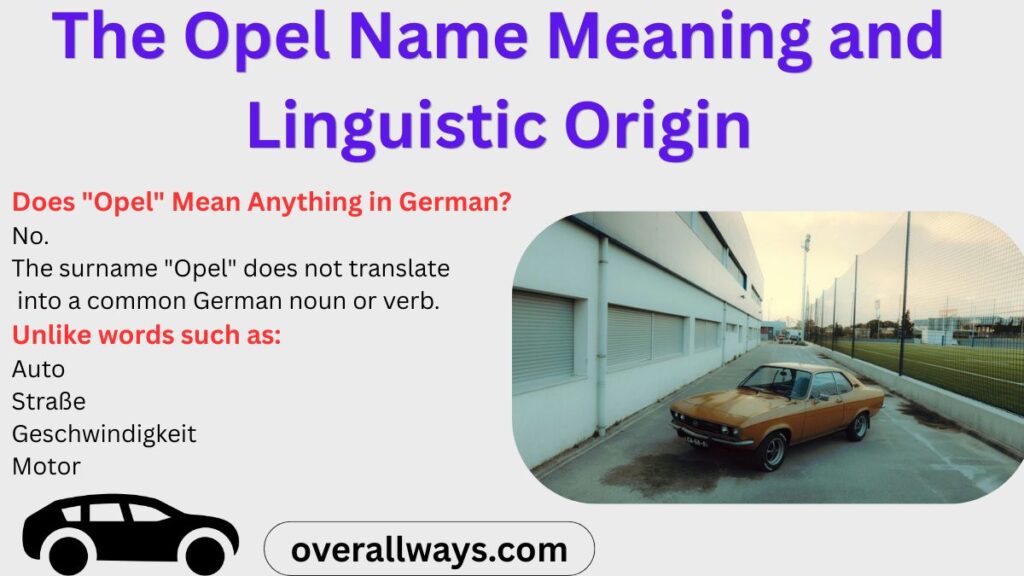
Although OPEL meaning comes from a family surname, many readers wonder whether the word has a hidden meaning in the German language.
Does “Opel” Mean Anything in German?
No.
The surname “Opel” does not translate into a common German noun or verb.
Unlike words such as:
- Auto
- Straße
- Geschwindigkeit
- Motor
“Opel” is a proper family name.
That makes the Opel word meaning unique because its value comes from more than 160 years of business history rather than dictionary definitions.
How to Pronounce Opel
The correct German pronunciation is close to:
OH-pel
The first syllable receives the strongest emphasis.
Many English speakers pronounce it correctly with only slight differences in accent.
Opel Logo Meaning and Symbolism
A brand’s logo often tells a story. Opel’s famous lightning bolt is no exception.
The modern Opel logo meaning reflects speed, innovation, engineering, and forward movement.
Today, the Opel emblem ranks among the most recognizable automotive symbols in Europe.
The Evolution of the Opel Logo
The company’s visual identity has changed many times throughout its long history.
| Period | Logo Characteristics |
|---|---|
| Late 1800s | Decorative typography using the Opel family name |
| Early 1900s | Circular and ornate designs |
| 1930s | Introduction of Zeppelin-inspired imagery |
| 1960s | Lightning bolt becomes dominant |
| Modern Era | Minimalist circular lightning bolt |
Each redesign reflected changing design trends while maintaining the company’s commitment to innovation.
What Does the Lightning Bolt Represent?
The famous Opel Blitz logo symbolizes:
- Speed
- Progress
- Modern technology
- Dynamic engineering
- Continuous innovation
The German word “Blitz” means lightning.
The symbol became closely associated with Opel after the success of the company’s Opel Blitz commercial truck introduced during the 1930s.
Its popularity eventually inspired the modern corporate logo.
The Circle Around the Lightning Bolt
The surrounding ring carries its own symbolism.
It often represents:
- Unity
- Global reach
- Continuous movement
- Engineering precision
Together, the lightning bolt and circular ring communicate a brand focused on efficient mobility and technological progress.
Opel’s Design Philosophy
Over the decades, Opel branding has favored simplicity over extravagance.
Rather than creating highly decorative badges, Opel emphasizes:
- Clean lines
- Functional elegance
- German precision
- Timeless recognition
This design philosophy extends beyond the logo into vehicle styling, interior layouts, and product development.
Also like
What Does LWK Mean in Text? The Complete Guide to Its Meaning, Uses, and Contexts
What Does “SH” Mean in Text? A Complete Guide to Its Uses and Interpretation
What Does DHZ Mean in Text? Complete Guide to Its Meanings, Uses, and Contexts
The Hidden Story Behind the Opel Brand
The hidden story of Opel is not about secret meanings or mysterious symbols.
Instead, it is a remarkable example of business adaptation.
Very few companies survive for more than 160 years.
Even fewer successfully transform themselves multiple times.
Opel achieved exactly that.
From Sewing Machines to Cars
Many companies struggle to reinvent themselves.
Opel embraced change repeatedly.
The company’s evolution followed this path:
Sewing Machines
        ↓
Bicycles
        ↓
Automobiles
        ↓
Mass Production
        ↓
Global Automotive Brand
        ↓
Electric Mobility
Each transition required new skills, new investments, and new technology.
Instead of resisting innovation, Opel consistently adapted to changing markets.
Innovation Has Always Driven Opel
Throughout its history, Opel innovation has focused on making advanced technology accessible to ordinary drivers.
Rather than producing only luxury vehicles, Opel concentrated on practical transportation.
Examples include:
- Fuel-efficient family cars
- Affordable compact vehicles
- Practical commercial vans
- Electric mobility solutions
- Driver assistance technologies
This customer-first philosophy remains one of Opel’s defining characteristics.
The Opel Business Story
Every successful brand develops around a clear identity.
For Opel, that identity centers on three principles.
Engineering
Vehicles should perform reliably every day.
Affordability
Innovation should remain accessible.
Practicality
Cars should solve real transportation needs.
Those principles explain why millions of drivers across Europe have trusted Opel for generations.
Opel’s Place in Automotive History
The history of Opel extends far beyond manufacturing automobiles.
The company helped shape European transportation throughout the twentieth century.
Today, Opel remains one of Germany’s most historically important automotive manufacturers.
Major Milestones in Opel History
| Year | Milestone |
|---|---|
| 1837 | Adam Opel born |
| 1862 | Company founded in Rüsselsheim |
| 1886 | Bicycle production begins |
| 1895 | Adam Opel dies |
| 1899 | First Opel automobile produced |
| 1924 | Modern assembly line introduced |
| 1929 | General Motors acquires majority stake |
| 2017 | PSA Group purchases Opel |
| 2021 | Opel joins Stellantis |
These milestones illustrate how the company evolved alongside the modern automotive industry.
Famous Opel Vehicles
Several models helped define the Opel legacy.
Opel Astra
One of Europe’s most successful compact cars.
Known for:
- Efficiency
- Reliability
- Comfortable driving
- Modern technology
Opel Corsa
The Opel Corsa has remained one of Europe’s best-selling small cars for decades.
Popular because of:
- Low operating costs
- Compact dimensions
- Excellent fuel economy
- Urban practicality
Opel Insignia
Designed for drivers seeking premium comfort without premium pricing.
Highlights include:
- Spacious interior
- Advanced safety systems
- Efficient engines
- Executive styling
Opel Mokka
The Opel Mokka reflects the growing demand for compact SUVs.
Its strengths include:
- Modern styling
- Electric variant availability
- Smart connectivity
- Comfortable ride quality
Other Popular Opel Models
Additional well-known vehicles include:
- Opel Crossland
- Opel Grandland
- Opel Combo
- Opel Vivaro
- Opel Zafira
- Opel Frontera
- Opel Rocks Electric
Together, these vehicles demonstrate Opel’s ability to serve families, businesses, commuters, and commercial customers.
Opel and Vauxhall: What’s the Difference?
Many people assume Opel and Vauxhall are separate manufacturers.
They’re actually closely connected.
Why Two Brand Names?
Historically:
- Opel serves most European markets.
- Vauxhall serves the United Kingdom.
Although the badges differ, many vehicles share:
- The same engineering
- Similar interiors
- Shared production platforms
- Nearly identical specifications
For decades, both brands operated under General Motors before becoming part of PSA Group and later Stellantis.
Opel vs. Vauxhall Comparison
| Feature | Opel | Vauxhall |
|---|---|---|
| Primary Market | Continental Europe | United Kingdom |
| Headquarters | Germany | United Kingdom Brand |
| Parent Company | Stellantis | Stellantis |
| Vehicle Platforms | Shared | Shared |
| Engineering | Shared | Shared |
For most buyers, the differences involve branding rather than engineering.
Opel’s Electric Future
The automotive industry is changing rapidly.
Electrification now shapes the future of transportation.
Opel has committed significant resources toward electric mobility.
Opel’s EV Strategy
The company plans to expand its lineup of battery-electric vehicles across multiple market segments.
Current electric offerings include models based on:
- Opel Corsa Electric
- Opel Mokka Electric
- Opel Rocks Electric
- Opel Combo Electric
- Opel Vivaro Electric
This strategy supports stricter European emissions regulations while meeting growing customer demand.
Sustainability Goals
Modern Opel vehicles increasingly emphasize:
- Reduced emissions
- Efficient battery technology
- Lightweight construction
- Renewable manufacturing practices
- Improved energy efficiency
These efforts align with Stellantis’ broader sustainability objectives.
Innovation Beyond Electric Cars
Future mobility involves much more than battery power.
Opel continues investing in:
- Connected vehicle technologies
- Driver assistance systems
- Digital dashboards
- Advanced safety engineering
- Smart manufacturing
The company aims to combine traditional German engineering with next-generation mobility solutions.
Expert Observation: Opel’s greatest strength has never been building the fastest or most expensive vehicles. Instead, its success comes from consistently delivering practical innovation to everyday drivers. That philosophy has guided the brand from sewing machines in the nineteenth century to electric vehicles in the twenty-first.
In the final part, we’ll cover fascinating Opel facts, common myths, practical buying considerations, comparison tables, frequently asked questions, expert tips, key takeaways, and a comprehensive conclusion, along with authoritative references to support the information presented throughout the article.
Interesting Facts About Opel You Should Know
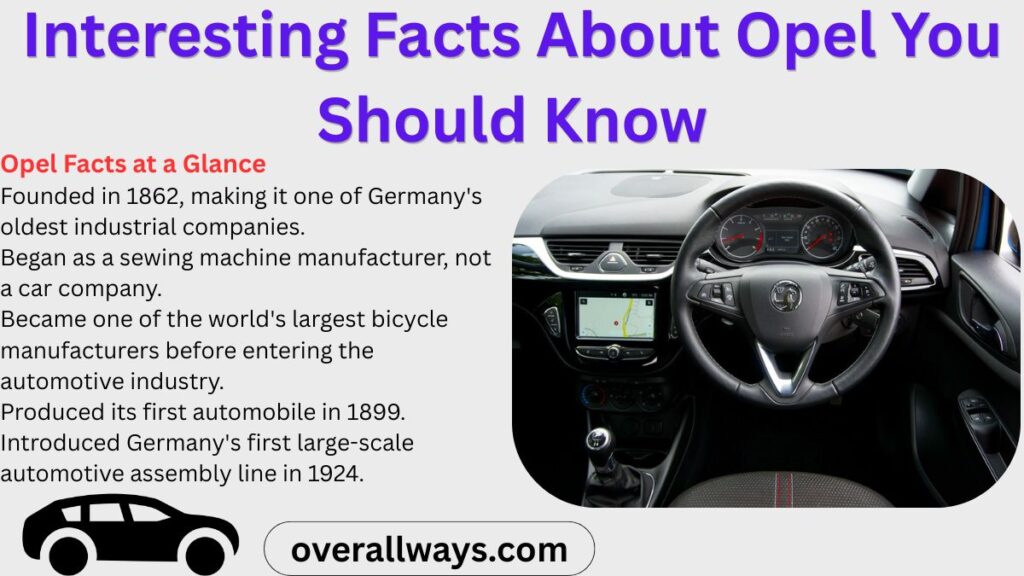
The Opel brand has a rich history filled with milestones that many people have never heard about. These facts help explain why Opel remains one of Europe’s most respected automotive manufacturers.
Opel Facts at a Glance
- Founded in 1862, making it one of Germany’s oldest industrial companies.
- Began as a sewing machine manufacturer, not a car company.
- Became one of the world’s largest bicycle manufacturers before entering the automotive industry.
- Produced its first automobile in 1899.
- Introduced Germany’s first large-scale automotive assembly line in 1924.
- Has manufactured tens of millions of vehicles over its history.
- Operates from Rüsselsheim am Main, Germany, where the company was founded.
- Is now part of Stellantis, one of the world’s largest automotive groups.
These milestones highlight the remarkable Opel brand journey and its lasting contribution to the European automotive industry.
Opel at a Glance
| Category | Details |
|---|---|
| Brand Name | Opel |
| Meaning of OPEL | Founder’s family surname |
| Founder | Adam Opel |
| Founded | 1862 |
| Headquarters | Rüsselsheim am Main, Germany |
| Industry | Automobile Manufacturing |
| Parent Company | Stellantis |
| Original Business | Sewing Machines |
| First Automobile | 1899 |
| Current Focus | Passenger Cars, SUVs, Commercial Vehicles, Electric Vehicles |
Why Is Opel Famous?
Many people know Opel because of its affordable family cars. However, its reputation comes from much more than competitive pricing.
Engineering Excellence
For decades, Opel engineering has focused on building vehicles that balance:
- Comfort
- Safety
- Efficiency
- Reliability
- Practical performance
Rather than competing directly with luxury manufacturers, Opel has consistently designed vehicles for everyday drivers.
A Pioneer in Mass Production
When Opel introduced assembly-line production in the 1920s, it dramatically increased manufacturing efficiency. This allowed more families to purchase reliable automobiles at affordable prices.
That decision helped shape the German automobile industry for generations.
Innovation for Everyday Drivers
Many automotive innovations eventually become standard features across the industry.
Opel has contributed to advances in:
- Fuel-efficient engines
- Driver assistance technologies
- Vehicle safety systems
- Electric mobility
- Connected vehicle technology
Instead of chasing headlines, Opel has often focused on practical improvements that make daily driving easier.
Also like
28+ Other Ways to Say “Thank You for the Opportunity”
What Does “CYA” Mean in Text? Meaning, Examples, and When to Use It
32+ Other Ways to Say “Have a Great Weekend”
Case Study: How Opel Reinvented Itself
One of the best examples of business resilience is Opel’s ability to adapt.
Challenge
The automotive industry has experienced enormous changes over the past century, including:
- Economic recessions
- World wars
- Oil crises
- Global competition
- Electrification
- Digital transformation
Many historic manufacturers disappeared.
Opel’s Response
Rather than resisting change, Opel repeatedly evolved by:
- Modernizing production
- Improving engineering
- Expanding globally
- Joining strategic partnerships
- Investing in electric vehicles
Result
Today, Opel continues to manufacture vehicles across Europe while benefiting from Stellantis’ global resources.
This transformation demonstrates why the hidden story behind the Opel brand is really a story of continuous innovation and resilience.
Common Myths About Opel
Many misconceptions continue to circulate online. Let’s separate fact from fiction.
| Myth | Reality |
|---|---|
| Opel is an acronym. | False. It is the founder’s surname. |
| Opel is no longer German. | False. It remains a German brand headquartered in Rüsselsheim. |
| Opel and Vauxhall are different manufacturers. | False. They share engineering and ownership under Stellantis. |
| Opel only makes small cars. | False. Opel also produces SUVs, vans, commercial vehicles, and electric models. |
| Opel stopped making vehicles. | False. Opel remains an active automobile manufacturer. |
Pros and Challenges of the Opel Brand
Every automotive manufacturer has strengths and areas for improvement.
Pros
- Long automotive heritage
- Strong German engineering reputation
- Reliable family vehicles
- Competitive pricing
- Growing electric vehicle lineup
- Wide dealer network across Europe
- Practical and efficient designs
Challenges
- Limited presence outside Europe
- Strong competition from Asian manufacturers
- Premium brands dominate certain market segments
- Transition to electric mobility requires continued investment
Understanding these strengths and challenges helps buyers make informed decisions.
Expert Tips for Buying an Opel Vehicle
If you’re considering an Opel, keep these recommendations in mind.
Match the Vehicle to Your Needs
Different models serve different drivers.
- Opel Corsa — Ideal for city driving.
- Opel Astra — Excellent all-around family hatchback.
- Opel Mokka — Compact SUV with modern technology.
- Opel Grandland — Larger SUV for growing families.
- Opel Vivaro — Suitable for commercial use.
Research Local Parts Availability
Although Opel has an extensive European network, parts availability varies by country.
Always confirm:
- Dealer support
- Service centers
- Replacement part availability
- Warranty coverage
Consider Electric Options
If charging infrastructure is available where you live, Opel’s expanding electric lineup may reduce long-term operating costs.
Best Practices for Researching Any Car Brand
When evaluating manufacturers like Opel, focus on trusted information rather than marketing claims.
Use this checklist:
- Review official manufacturer specifications.
- Compare independent safety ratings.
- Read long-term ownership reviews.
- Check maintenance costs.
- Verify warranty details.
- Compare fuel or energy efficiency.
- Evaluate resale value in your region.
Following these steps helps buyers make better-informed decisions.
Common Mistakes People Make
Many readers searching for OPEL meaning explained make the same mistakes.
Avoid these assumptions.
Assuming Opel Is an Acronym
It isn’t.
The company name comes directly from Adam Opel.
Confusing Ownership with Brand Identity
Although Opel belongs to Stellantis, it remains a German automotive brand with German engineering roots.
Believing Opel and Vauxhall Are Completely Different
Most modern Opel and Vauxhall models share the same engineering platform.
The primary difference is branding.
Frequently Asked Questions
What does Opel actually mean?
The OPEL meaning comes from the surname of founder Adam Opel. It is not an acronym or abbreviation.
Is Opel an acronym?
No.
There is no official OPEL acronym or OPEL abbreviation.
Who founded Opel?
Adam Opel founded the company in 1862 in Rüsselsheim, Germany.
Why is Opel called Opel?
The company was named after its founder, following a common nineteenth-century business tradition.
Is Opel a German company?
Yes.
Opel remains headquartered in Germany and is recognized as a German automobile manufacturer.
Who owns Opel today?
Stellantis owns Opel following the 2021 merger between PSA Group and Fiat Chrysler Automobiles.
What does the Opel logo represent?
The famous lightning bolt symbolizes speed, innovation, and engineering progress.
What cars does Opel make?
Current vehicle categories include:
- Hatchbacks
- Sedans
- SUVs
- Commercial vans
- Electric vehicles
Popular models include the Astra, Corsa, Mokka, Grandland, Vivaro, and Combo.
Is Opel still in business?
Yes.
Opel continues to design, manufacture, and sell vehicles throughout Europe and several international markets.
Why is Opel famous?
Opel is known for reliable engineering, practical family vehicles, affordable innovation, and more than 160 years of automotive heritage.
Conclusion
Understanding the OPEL meaning reveals much more than the origin of a company name. It tells the story of one family, one city, and more than a century and a half of industrial innovation.
What started as Adam Opel’s sewing machine workshop in 1862 gradually transformed into one of Europe’s most influential automobile manufacturers. Through changing technologies, global competition, and multiple ownership transitions, Opel remained committed to practical engineering, dependable vehicles, and accessible innovation.
Today, the Opel brand continues that legacy under Stellantis, combining its historic German engineering expertise with modern electric mobility and advanced automotive technologies. Its vehicles continue to serve millions of drivers who value reliability, efficiency, and thoughtful design.
For anyone asking “What does Opel mean?”, the answer is simple. Opel is the family name of its founder. Yet behind that single name lies a remarkable story of perseverance, adaptation, and engineering excellence that has shaped the automotive industry for more than 160 years.

Hi, I’m Oliver Grant. I write about word meanings, slang terms, acronyms, and communication tips. Through Overall Ways, I help readers learn new words, understand modern language trends, and communicate more effectively.
