
Poison Tree Tattoo Meaning: Symbolism, Origins & Design Guide (2026)
Some tattoos decorate skin. Others carry a story on their back for life. The poison tree tattoo Meaning belongs firmly in the second category. It looks striking on its own — twisted branches, a single glowing apple, maybe a serpent curled through the roots. But underneath the ink sits one of the most quietly brutal poems in the English language, and once you know it, you can’t un-know it.
This guide breaks down the full poison tree tattoo meaning, where the image actually comes from, how it connects to mythology and psychology far beyond one 18th-century poet, and how to choose a design that says what you actually want it to say.
What Is a Poison Tree Tattoo?
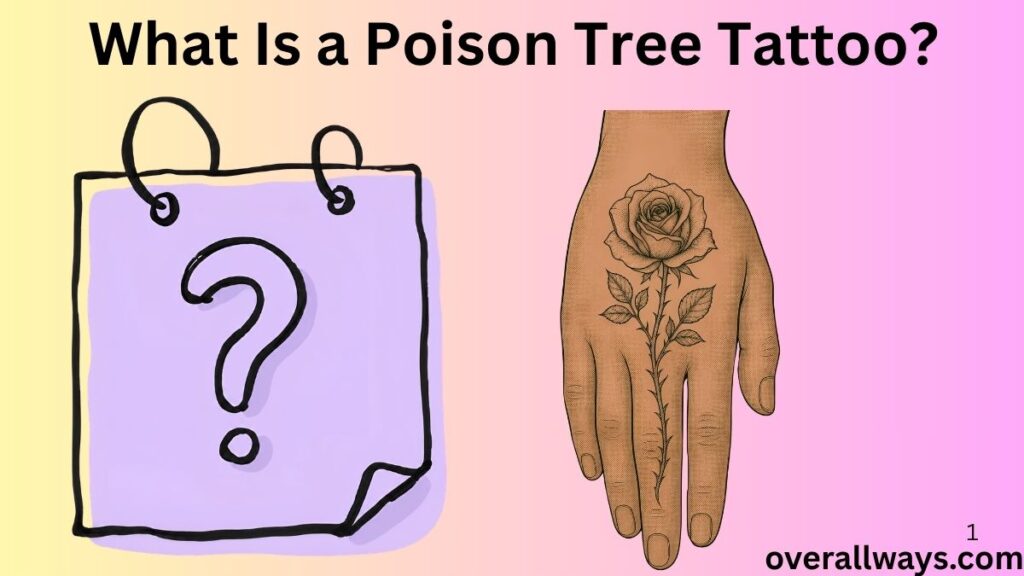
A poison tree tattoo is a symbolic tree tattoo built around one central idea: something beautiful on the outside can be lethal underneath. Unlike a Tree of Life design, which usually celebrates growth, family, or connection, the poison tree carries tension. It’s not a peaceful image. It’s a warning wearing the shape of a decoration.
Most designs revolve around a twisted or half-dead tree, often bearing a single piece of fruit — usually an apple — that glows or stands out against otherwise dark branches. Some versions add a serpent. Others show roots that look more like veins, hinting that whatever poisoned the tree came from somewhere internal, not external.
Here’s what separates a true poison tree tattoo from a generic dark-tree design: tattoo symbolism in this style always ties back to a narrative, whether that’s Blake’s poem, a Genesis reference, or a personal story about a grudge, a betrayal, or an emotion someone finally decided to stop swallowing.
Two traditions feed into this image:
- Literary — rooted directly in William Blake’s 1794 poem
- Botanical and mythological — drawing on real toxic trees and ancient stories about forbidden fruit
Most people getting this tattoo today are blending both without necessarily knowing the second one exists. That’s exactly what this guide is here to fix.
The Origins: William Blake’s “A Poison Tree” (1794)
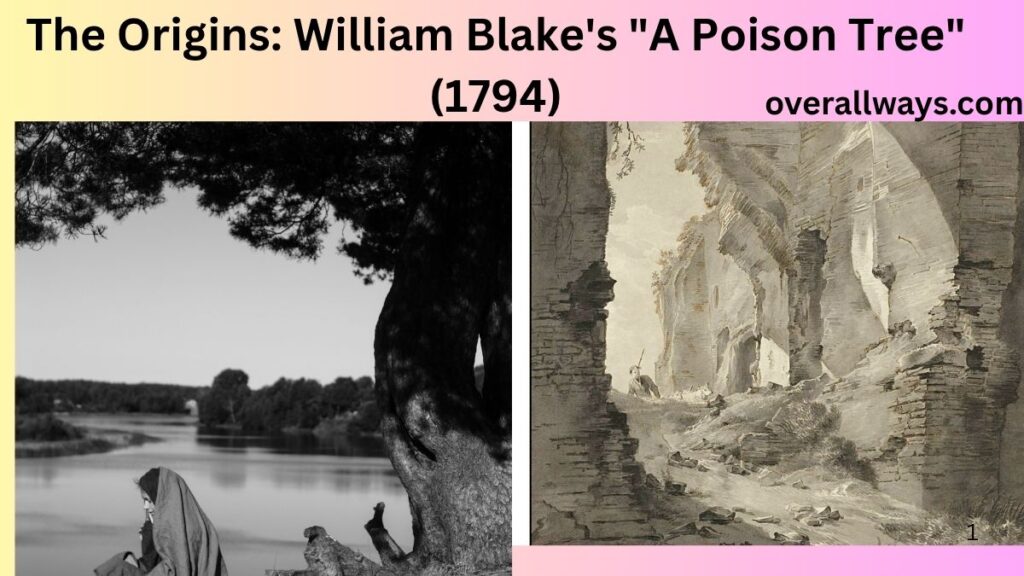
The poison tree tattoo meaning starts with a single poem, and you can’t really understand the design without understanding the text behind it.
William Blake published “A Poison Tree” in 1794 as part of Songs of Experience, the darker companion volume to his earlier Songs of Innocence.
Here’s a detail almost Poison Tree Tattoo Meaning nobody mentions, and it changes how you read the whole piece: in his notebook, Blake originally called this poem “Christian Forbearance.”
That’s the entire allegory in a nutshell: suppressed anger, left to grow in the dark, eventually kills something. Sometimes a relationship. Sometimes, in Blake’s version, a person.
A few more facts worth knowing if you’re planning this tattoo:
| Detail | Fact |
|---|---|
| First published | 1794, in Songs of Experience |
| Original working title | “Christian Forbearance” |
| Structure | Four quatrains, rhyming couplets (AABB) |
| Central image | A tree grown from hidden wrath, bearing one poisoned apple |
| Biblical parallel | Genesis 2–3, the Tree of Knowledge |
| Known illustration | Blake’s own hand-painted plate, held at the Metropolitan Museum of Art |
Blake didn’t just write the poem — he etched and hand-painted the illustration himself, as he did with all his “illuminated books.” His original plate shows a writhing, almost serpent-like tree with a distant human figure nearby. If you’ve seen a “Blake-inspired” poison tree tattoo, there’s a good chance it’s referencing this exact image, whether the artist realized it or not.
There’s also a lesser-known scholarly theory worth mentioning. Researcher Andrew Stauffer has connected the poem’s “apple bright” to the Manchineel tree, a real, extremely toxic species native to the Caribbean and parts of Central America, sometimes nicknamed the “beach apple” or, more ominously, the “little apple of death.”
Poison Tree Tattoo Meaning: Core Symbolism
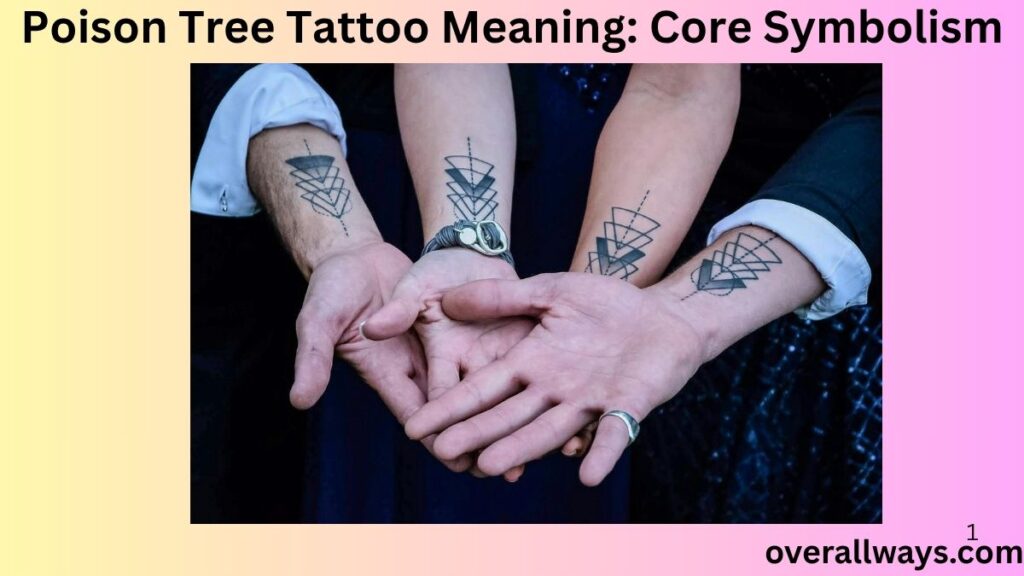
Strip away the literary history, and the poison tree tattoo meaning comes down to a handful of core ideas people connect with:
- Suppressed anger — the emotional weight of never saying what you actually feel
- Emotional repression and how it compounds over time instead of fading
- Deception — beauty on the surface, harm underneath
- Cycles of resentment — how silence, not confrontation, is often what keeps conflict alive
- A warning, not a celebration — most people wear this design as a reminder, not a badge of pride
That last point matters a lot, and it’s where a lot of casual observers get the tattoo wrong. Seeing a poison tree and assuming it glorifies revenge misses the actual message of the poem. Blake’s speaker isn’t a hero. The final image of him feeling glad about his enemy’s death is meant to be unsettling, not admirable. Most people who choose this tattoo understand that distinction, and use the design as a personal note to self: don’t let this happen to you.
Compare it to a standard Tree of Life tattoo, which usually leans into themes of growth, family roots, and interconnection. The poison tree flips that script. Instead of roots that nourish, you get roots that poison. Instead of branches reaching toward light, you get branches that twist inward. It’s the same basic tree shape carrying an almost opposite emotional charge.
Who Gets a Poison Tree Tattoo — and Why
People choose this design for a range of very specific, very personal reasons. A few patterns show up again and again:
- People marking the end of a period of bottled-up anger — often after finally confronting something they’d stayed quiet about for too long
- People processing a betrayal or a toxic relationship, using the image as both a scar and a lesson
- Literature and poetry lovers who want a piece specifically tied to Blake’s text, not just a vague nature tattoo
- Fans of gothic and dark-academia aesthetics, where twisted trees, ravens, and moon imagery already fit the visual language
- People actively doing shadow work or therapy, using the tattoo as a permanent reminder to name their feelings instead of burying them
A betrayal tattoo and a heartbreak tattoo often overlap heavily with poison tree designs, since the poem’s central relationship — friend versus foe, honesty versus resentment — maps directly onto real breakups, friendships gone wrong, and family conflict. It’s less about advertising pain to other people and more about keeping a private conversation with yourself visible.
Popular Design Variations
The poison tree concept is flexible enough to support a wide range of visual styles. Here’s how the most common approaches differ.
Black and Grey Gothic Style
Heavy shading, sharp branch detail, and high contrast define this approach. It leans into the darker emotional tone of the source material and pairs naturally with other Poison Tree Tattoo Meaning elements like ravens, moths, or skulls. This is the most common style for people who want the design to read as unmistakably ominous.
Blake-Inspired Illustration
This version draws directly from Blake’s 1794 plate — a writhing, almost serpentine trunk, sparse foliage, and a single glowing apple. It’s the closest thing to a “literal” translation of the poem into ink, and it appeals most to people who want the Poison Tree Tattoo Meaning tied specifically to the literary tattoo tradition rather than a generic dark-tree look.
Half-Dead, Half-Living Tree
One side of the tree is barren and cracked; the other is green and thriving. This variation shifts the meaning slightly toward emotional healing and emotional recovery — the idea that you can hold both the damage and the growth in the same image, rather than pretending the damage never happened.
Serpent and Apple Motif
Adding a serpent coiled around the trunk pulls the design closer to its Genesis roots, reinforcing the Tree of Knowledge and forbidden fruit symbolism underneath Blake’s poem. This version tends to appeal to people drawn to the biblical layer of the story as much as the literary one.
Heart-Shaped Fruit Design
Replacing the apple with a heart-shaped fruit makes the emotional subtext explicit — this is a tree that grows from feelings, not just abstract “wrath.” It’s a popular choice for people using the design specifically as a heartbreak tattoo.
Minimalist Line Art
A single continuous line forming the tree, sometimes with one small dot or shape for the apple. This style suits smaller placements like the wrist or behind the ear, and works well for people who want the meaning without a large, visually loud piece.
Watercolor Style
Soft, bleeding color washes soften what is otherwise a heavy theme. This approach is popular with people who connect with the story but don’t want their tattoo to look aggressive or gothic — proof that watercolor tattoo techniques can carry serious meaning without a heavy visual tone.
Color Meanings in Poison Tree Tattoos
Color choice changes the emotional register of the design significantly. Here’s a quick breakdown:
| Color Choice | What It Tends to Communicate |
|---|---|
| Black and grey | Restraint, permanence, a gothic and timeless feel |
| Red apple/fruit accent | Danger, temptation, the “bait” at the center of the story |
| Sickly green or yellow | Literal toxicity, decay, physical corruption |
| Muted watercolor tones | Softness paired with a heavy theme, often chosen for smaller or more personal placements |
| Deep purple or blue shadows | Melancholy, introspection, quieter forms of grief |
There’s no single “correct” palette. The color is really a volume knob — it decides how loudly the tattoo announces its meaning versus how much it keeps that meaning private.
Best Placement Options for a Poison Tree Tattoo
Tattoo placement matters more with this design than with a lot of others, because the level of visual detail in a poison tree piece scales up or down depending on available space.
- Forearm tattoo — Great visibility and enough canvas for branching detail without going oversized. A common choice for people who want the tattoo to be part of everyday conversation.
- Ribcage or back — Ideal for larger, more elaborate scenes that include the full tree, roots, serpent, and apple together. This is where a spine tattoo version of the design, running the length of the backbone as a single trunk, tends to look most striking.
- Behind the ear or wrist — Best suited to minimalist single-branch or single-apple versions. Small, private, and easy to keep low-key.
- Chest tattoo — Popular for people who want the design close to the heart, literally, especially in the heart-shaped-fruit variation.
- Thigh or calf — Gives enough room for a full narrative scene, including a human figure, which some Blake-inspired designs include as a nod to the original illustration.
A common design mistake worth flagging directly: cramming a highly detailed, multi-element scene (tree, serpent, apple, figure, roots) into a small placement like a wrist. Detail this dense needs real space to read clearly years down the line, once the ink has settled and softened.
Mythological and Cross-Cultural Parallels: Poison Trees Beyond Blake
Blake didn’t invent the idea of a beautiful, dangerous tree out of nowhere. The image sits inside a much older pattern found across world mythology, and knowing this context adds real depth to the tattoo’s meaning.
Garden of Eden and the Tree of Knowledge — The most direct parallel. In Genesis, a single forbidden fruit leads to humanity’s fall from grace. Blake deliberately echoes this structure, but flips the roles: his speaker plays both God (the one who planted the tree) and the serpent (the one who tempts). That double role is part of what makes the poem so uncomfortable — the villain and the moral authority are the same person.
Greek mythology and the Hesperides golden apples — In Greek myth, golden apples grow in the garden of the Hesperides, guarded by a dragon-like serpent named Ladon. The apples are prized and dangerous to reach, tied to themes of temptation, immortality, and conflict (the same golden apples show up in the myth that triggers the Trojan War). The pattern repeats: a guarded, glowing fruit that draws people toward ruin.
Norse mythology, Yggdrasil, and Níðhöggr — Norse cosmology centers on Yggdrasil, the World Tree connecting all nine realms. At its roots lives Níðhöggr, a serpent or dragon that gnaws constantly at the tree, slowly working toward its destruction from below. It’s a strikingly similar image to the poison tree’s inward-facing corruption — decay working from the inside, hidden from view, until it eventually surfaces.
Buddhist philosophy — Buddhist teaching frames unresolved anger and attachment as a source of ongoing suffering, something that has to be examined and released rather than buried.
Put side by side, these traditions all land on the same basic warning, expressed through different trees, different fruit, and different serpents: things that grow in secret tend to grow wrong.
Psychological Dimension: Why This Symbol Resonates So Deeply
The psychological symbolism behind a poison tree tattoo goes beyond literature. It taps into something almost everyone has actually lived through.
Nearly everyone has held onto anger they never voiced. Maybe it felt safer to stay quiet. Maybe the relationship mattered too much to risk a confrontation. Blake’s poem captures exactly what happens next: the feeling doesn’t fade just because it stays unspoken. It gets watered, in his words, by fear and tears, and sunned by fake smiles — a private, dishonest kind of maintenance that lets resentment keep growing under a friendly surface.
This connects directly to Carl Jung’s concept of the shadow self — the parts of our personality we push down, deny, or refuse to look at directly. Jung argued that the shadow doesn’t just sit there quietly. Left unexamined, it tends to leak out sideways, through passive aggression, sabotage, or sudden emotional outbursts that seem disproportionate to whatever triggered them.
For a lot of people, the tattoo functions less like decoration and more like an externalized reminder — not unlike a sobriety date tattoo or a memorial piece. It’s a permanent note that says: I know what happens when I bury this instead of dealing with it. Choosing to get it can itself be an act of self-awareness, a way of committing, publicly or privately, to emotional boundaries and honesty instead of quiet resentment.
It’s worth being honest about something here, though: a tattoo is a symbol, not a substitute for actually processing difficult emotions or overcoming betrayal.
FAQs: Poison Tree Tattoo Meaning
Is a poison tree tattoo a negative symbol?
Not inherently. While the poem’s plot is dark, most people wear the design as a warning or a lesson, not a celebration of revenge. Read in context, it’s closer to a resilience tattoo than a threat — a reminder to deal with anger honestly instead of letting it fester.
Does a poison tree tattoo have to reference William Blake?
No. Plenty of people connect with the general poison tree symbolism — beauty concealing danger, hidden anger, toxic relationships — without knowing the poem exists. That said, once you know the source, the design tends to carry a lot more weight.
What does a poison tree tattoo mean for women?
There’s no documented gender-specific meaning attached to this design in tattoo tradition, and it’s worth being skeptical of any source claiming otherwise. The symbolism centers on universal emotional experience — suppressed anger, toxic relationships, emotional recovery — none of which is gender-bound.
Can a poison tree tattoo symbolize healing?
Yes, especially in the half-dead, half-living variation. Many people intentionally choose a design that shows both damage and new growth, turning the piece into a transformation tattoo rather than a purely dark statement.
How long does a poison tree tattoo take to complete?
It depends heavily on size and style. A minimalist wrist version might take under an hour. A detailed black and grey ribcage or spine piece with roots, serpent, and full branch structure can take multiple sessions across several weeks.
Conclusion
A poison tree tattoo isn’t just a moody piece of nature-inspired ink. It’s a 230-year-old warning about what happens when anger goes unspoken, dressed up as a single glowing apple on a twisted branch. Whether you’re drawn to it because you know Blake’s poem line for line, because the Genesis and Eden imagery speaks to you, or simply because the “beautiful but dangerous” concept matches something you’ve lived through, the design carries real weight far beyond its visual appeal.
If you’re planning this tattoo, take the time to decide which layer of meaning matters most to you — the literary reference, the mythological echoes, or the personal, psychological one — and let that decision guide your design choices, from color to placement to how much detail you actually want carrying that story on your skin. Bring this guide to your consultation, talk through the variation that fits your story, and make sure your artist understands the meaning you’re trying to carry, not just the shape you want them to draw.Some tattoos decorate skin. Others carry a story on their back for life.

Hi, I’m Olivia Bennett, a content writer passionate about word meanings, slang definitions, acronym explanations, and communication guides. Through Overall Ways, I help readers understand modern language trends, improve their vocabulary, and discover better ways to express themselves with confidence
