
The phrase poignant meaning often appears when people search for emotional words that carry depth, sensitivity, and reflection. Yet many readers still misunderstand the word. Some assume it only means “sad.” Others confuse it with sentimental language or dramatic expression.
In reality, poignant describes something that creates a strong emotional reaction, usually through a mix of beauty, sadness, nostalgia, truth, or empathy. A poignant scene doesn’t just make you feel emotional. It lingers. It stays with you long after the moment passes.
This guide explains the true word definition, emotional nuance, historical background, modern usage, and practical applications of the word poignant. You’ll also learn how writers, journalists, creators, and everyday speakers use it naturally in conversations, social media, literature, and professional writing.
What Does “Poignant” Mean?
The simplest dictionary entry defines poignant as:
“Evoking a keen sense of sadness or regret.”
However, that definition only captures part of the picture.
The modern emotional term goes deeper than sadness alone. A poignant experience often combines several emotions at once:
- Joy and grief
- Hope and loss
- Warmth and nostalgia
- Love and reflection
- Beauty and pain
That emotional layering creates what many describe as a bittersweet feeling.
Simple Definition in Plain English
A poignant moment is emotionally powerful in a thoughtful and moving way.
For example:
- A father watching old home videos after his children move away
- A graduation speech honoring a late teacher
- A handwritten letter from someone who passed away
- A final scene in a movie that mixes happiness with goodbye
These moments create deep feelings because they connect emotion with memory, humanity, and reflection.
Why the Word Feels Emotionally Powerful

The word poignant carries strong sentiment resonance because it appeals to human vulnerability.
Unlike dramatic words such as devastating or tragic, poignant situations often feel quiet and personal.
That subtlety matters.
A poignant scene doesn’t scream for attention. Instead, it creates a slow emotional ache. You feel it in silence. Like a song that suddenly reminds you of childhood. Or an old photograph tucked inside a drawer.
Key Emotional Traits of Something Poignant
| Emotional Element | Description |
|---|---|
| Nostalgia | Reflection on meaningful memories |
| Tenderness | Gentle emotional warmth |
| Loss | Awareness of absence or change |
| Humanity | Recognition of shared emotions |
| Reflection | Deep personal thought |
| Emotional Blend | Multiple emotions happening together |
This emotional complexity explains why the word appears frequently in:
- Film reviews
- Literature analysis
- Journalism style writing
- Therapy discussions
- Poetry critiques
- Memorial speeches
Does “Poignant” Always Mean Sad?
No. That’s one of the biggest common misconceptions.
Something poignant may include sadness, but it can also feel:
- Beautiful
- Loving
- Hopeful
- Reflective
- Inspiring
The emotional effect comes from emotional depth, not pure negativity.
Example of a Poignant Moment
Imagine an elderly couple dancing slowly at their 50th anniversary celebration while their favorite song plays.
That scene isn’t tragic. Yet it feels emotionally rich because it reflects time, aging, love, memory, and mortality all at once.
That layered emotional response defines poignancy.
How to Use “Poignant” Correctly in a Sentence
Many English learners understand the definition but struggle with real-world usage.
Here are natural usage examples that sound fluent and authentic.
Everyday Conversation Examples
- “Her farewell speech was surprisingly poignant.”
- “That movie ending felt really poignant.”
- “He shared a poignant story about his childhood.”
- “The photo became a poignant reminder of simpler times.”
Professional and Academic Usage
The word also appears often in formal language and academic context.
Examples:
- “The documentary offers a poignant critique of war.”
- “The author uses poignant imagery throughout the novel.”
- “The interview ended with a poignant reflection on loss.”
Common Word Pairings
Certain phrases appear repeatedly in English usage.
| Common Collocation | Meaning |
|---|---|
| Poignant memory | Emotionally meaningful recollection |
| Poignant reminder | Something that triggers reflection |
| Poignant speech | Deeply moving communication |
| Poignant quote | Emotionally memorable statement |
| Poignant scene | Emotionally affecting moment |
These combinations sound natural because native speakers use them frequently.
Real-Life Examples of Poignant Language
Language becomes easier to understand when you see it in context.
Literature Example
In many classic novels, writers use poignant scenes to humanize characters.
For example, in Of Mice and Men by John Steinbeck, loneliness and broken dreams create a deeply reflective emotional atmosphere.
The emotional power doesn’t come from dramatic action alone. It comes from vulnerability and unmet hope.
Film Example
Animated films often use poignant storytelling effectively.
Pixar’s Up opens with a nearly wordless montage showing love, aging, dreams, and grief. The sequence became famous because viewers experienced a strong affective response without much dialogue.
Journalism Example
News writers frequently use the word in memorial coverage or human-interest stories.
Example:
“The ceremony concluded with a poignant tribute to healthcare workers.”
This usage signals emotional respect without sounding exaggerated.
Poignant Meaning in Social Media and Online Communication
Modern digital culture changed how emotional vocabulary spreads.
Today, people use poignant across:
- Instagram captions
- TikTok videos
- WhatsApp chats
- Snapchat stories
- Online posts
- Dating apps
However, the word often gets overused incorrectly online.
How People Use “Poignant” on Social Media
Users commonly apply the word to:
- Reflective travel photos
- Emotional breakup posts
- Nostalgic family videos
- Tribute messages
- Graduation memories
- Anniversary captions
Example caption:
“Some memories hurt beautifully. Still grateful for every second.”
That type of reflective wording creates a poignant tone.
Why Poignant Language Performs Well Online
Emotion drives engagement.
Research from multiple digital marketing studies consistently shows that emotionally resonant content generates stronger sharing behavior than purely informational content.
A thoughtful post creates:
- Emotional connection
- Authenticity
- Empathy expression
- Stronger audience retention
That’s why creators increasingly use nuanced emotional vocabulary online.
Poignant Meaning in Dating Apps and Relationships
The word also appears frequently in dating apps and modern communication.
People often use poignant language to show emotional maturity and vulnerability.
Examples in Romantic Contexts
- “Looking for meaningful conversations and poignant moments.”
- “Old jazz songs always hit me in a poignant way.”
- “Your message had a surprisingly heartfelt effect.”
This type of wording signals:
- Emotional intelligence
- Reflective personality
- Depth of communication
- Thoughtful communication skills
In modern relationship culture, emotional articulation matters more than ever.
Synonyms of “Poignant” and Their Differences
Many related words overlap with poignant meaning, but each carries different emotional shades.
| Word | Emotional Tone | Best Use Case |
|---|---|---|
| Touching | Warm and emotional | Heartfelt stories |
| Emotional | Broad emotional response | General situations |
| Bittersweet | Happiness mixed with sadness | Nostalgic experiences |
| Heartfelt | Sincere emotion | Personal messages |
| Moving | Strong emotional reaction | Films and speeches |
| Sentimental | Emotional attachment | Personal memories |
Important Difference
Not all emotional content is poignant.
A loud emotional outburst may feel dramatic but not poignant.
Poignancy requires:
- subtlety
- reflection
- emotional depth
- emotional complexity
That distinction matters in both writing and speaking.
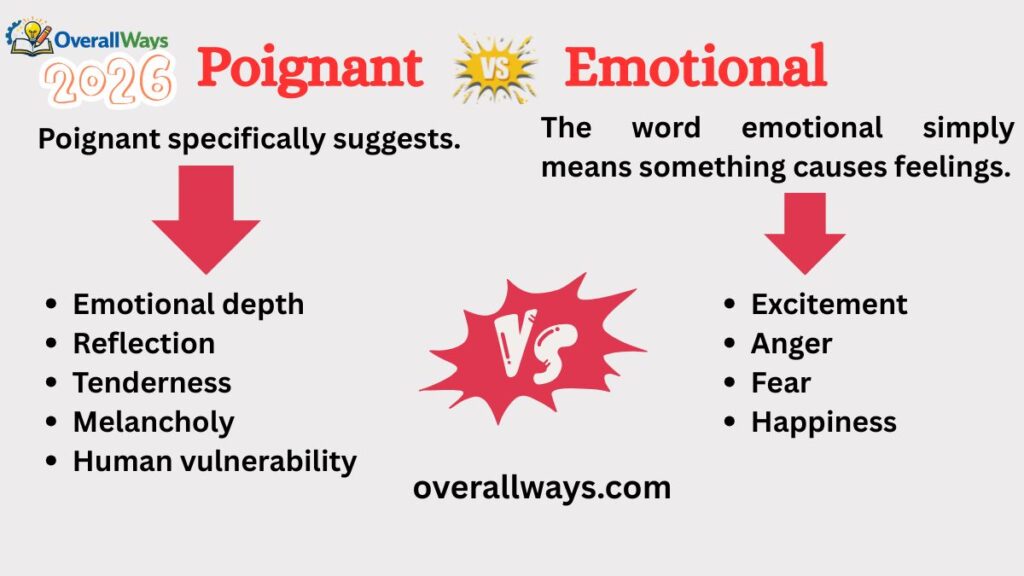
Poignant vs Emotional
This comparison confuses many readers.
Emotional
The word emotional simply means something causes feelings.
That could include:
- excitement
- anger
- fear
- happiness
Poignant
Poignant specifically suggests:
- emotional depth
- reflection
- tenderness
- melancholy
- human vulnerability
A football victory can feel emotional.
A soldier returning home after decades feels poignant.
The second example carries deeper human significance.
Common Mistakes People Make With “Poignant”
Even fluent speakers misuse the term occasionally.
Using It for Any Sad Situation
Not every sad event qualifies as poignant.
For instance:
- A random argument isn’t poignant
- A frustrating traffic jam isn’t poignant
- Losing Wi-Fi definitely isn’t poignant
Poignancy requires emotional significance and reflection.
Confusing “Poignant” With “Pungent”
This happens surprisingly often because the words sound somewhat similar.
| Word | Meaning |
|---|---|
| Poignant | Emotionally moving |
| Pungent | Strong smell or taste |
A poem can be poignant.
Garlic can be pungent.
Big difference.
Overusing the Word
Writers sometimes label every emotional scene as poignant. That weakens impact quickly.
Instead, reserve the word for moments with genuine emotional complexity.
Word Origin and Linguistic History
Understanding the word origin helps explain the emotional nuance behind the term.
The English word poignant came from Middle French, specifically the term poignant, meaning “pricking” or “piercing.”
That root traces further back to the Latin word pungere, meaning “to prick.”
Historical Evolution of Meaning
Originally, the word described physical sharpness.
Over time, the meaning evolved metaphorically.
Instead of physically piercing the body, poignant experiences “pierced” emotions and memory.
This shift reflects a fascinating example of linguistic history where physical sensation transformed into emotional language.
Etymology Timeline
| Time Period | Development |
|---|---|
| Latin Era | Pungere = to prick |
| Middle French | Emotional and sensory sharpness |
| Early English | Sharp emotional feeling |
| Modern Usage | Deeply moving emotional impact |
This emotional metaphor remains powerful today.
Why Writers Love Using the Word “Poignant”
Professional writers value precise emotional language.
The word poignant offers nuance many simpler words lack.
Why It Works So Well
It signals:
- emotional sophistication
- reflective tone
- layered feeling
- subtle emotional intensity
That makes it popular in:
- literary critique
- journalism style writing
- screenplay reviews
- memoirs
- speeches
- poetry analysis
Example From Criticism
Instead of saying:
“The ending was sad.”
A critic might write:
“The ending delivered a poignant meditation on memory and aging.”
The second sentence sounds richer because it captures emotional texture.
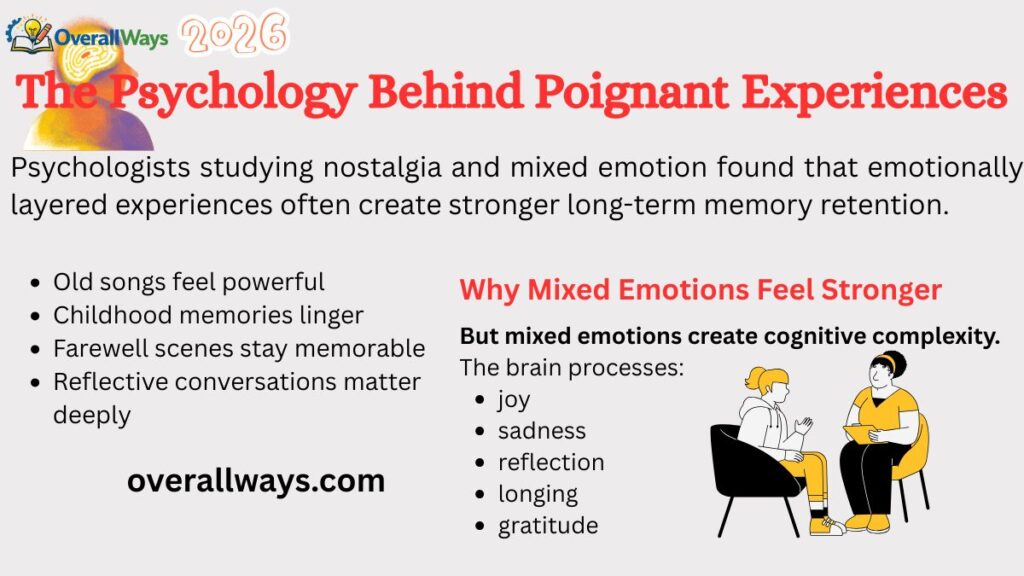
The Psychology Behind Poignant Experiences
Humans respond strongly to emotional contradiction.
Psychologists studying nostalgia and mixed emotion found that emotionally layered experiences often create stronger long-term memory retention.
That’s why:
- old songs feel powerful
- childhood memories linger
- farewell scenes stay memorable
- reflective conversations matter deeply
Why Mixed Emotions Feel Stronger
Pure happiness passes quickly.
But mixed emotions create cognitive complexity.
The brain processes:
- joy
- sadness
- reflection
- longing
- gratitude
all at once.
That emotional layering increases meaning and memorability.
Is “Poignant” Positive or Negative?
The answer depends entirely on context.
Positive Uses
Poignant experiences may feel:
- beautiful
- inspiring
- loving
- meaningful
Example:
“Her poignant speech united the audience.”
Negative Uses
The word can also reflect:
- grief
- regret
- loneliness
- emotional pain
Example:
“The abandoned house stood as a poignant reminder of disaster.”
Most uses combine both emotional warmth and sadness.
That duality creates the signature bittersweet feeling associated with the word.
Pronunciation and Grammar Guide
Correct Pronunciation
Poignant is pronounced:
POYN-yunt
Phonetic spelling:
/ˈpɔɪn.jənt/
Part of Speech
The word functions primarily as an adjective.
Examples:
- poignant memory
- poignant scene
- poignant remark
Related Forms
| Form | Usage |
|---|---|
| Poignant | Adjective |
| Poignantly | Adverb |
| Poignancy | Noun |
Example Usage
- “She spoke poignantly about her experience.”
- “The film captured the poignancy of growing older.”
Best Alternatives to “Poignant”
Sometimes another word fits better depending on tone.
For Creative Writing
Consider:
- evocative
- haunting
- reflective
- tender
- moving
For Business Communication
In business communication, softer alternatives often sound more professional.
Examples:
- meaningful
- thoughtful
- impactful
- sincere
For Academic Writing
Academic writers may prefer:
- emotionally resonant
- affective
- emotionally significant
Choosing the right synonym depends on audience and context.
Expert Tips for Using “Poignant” Naturally
Focus on Emotional Specificity
Don’t force the word into every emotional sentence.
Use it when:
- emotions feel layered
- memory matters
- reflection exists
- humanity feels central
Show Emotion Instead of Explaining It
Strong writing demonstrates poignancy through imagery and detail.
Weak:
“It was poignant.”
Better:
“He folded her final letter carefully before placing it back in the drawer.”
The second example creates emotional texture naturally.
Avoid Excessive Drama
Poignant writing often feels restrained.
Subtle emotional honesty usually works better than exaggerated sadness.
Real-World Usage Examples
Here are more realistic sentence illustrations.
Conversation Samples
- “That reunion scene was unexpectedly poignant.”
- “Your message really stayed with me.”
- “The documentary captured a poignant moment in history.”
Caption Ideas
- “Some memories never stop echoing.”
- “Beautiful things often leave the deepest scars.”
- “Time changes everything except certain feelings.”
Example of a Poignant Quote
“The hardest goodbyes are the ones filled with gratitude.”
That line works because it combines love, loss, and reflection simultaneously.
Google Trends and Popularity Over Time
Interest in emotionally expressive vocabulary increased significantly during the last decade.
Search behavior connected to:
- emotional wellness
- reflective communication
- mental health awareness
- storytelling content
- nostalgic media
continues rising.
Why Searches for “Poignant Meaning” Increased
Several factors contribute:
| Factor | Impact |
|---|---|
| Emotional storytelling online | Higher usage exposure |
| TikTok emotional content | Vocabulary spread |
| Mental health discussions | Emotional awareness |
| Relationship communication trends | Greater nuance in language |
| Search education habits | More vocabulary lookups |
Terms tied to emotional nuance often experience periodic popularity spikes on Google Trends, especially after viral films, speeches, or cultural events.
FAQs
What is the exact Poignant Meaning?
Poignant Meaning refers to something that creates deep emotional feelings, often through sadness, nostalgia, tenderness, or reflection. It describes moments that leave a lasting emotional impact.
Does poignant always mean sad?
No. A poignant experience can include happiness, gratitude, love, or hope along with sadness. The word usually describes a strong emotional blend rather than pure grief.
What is an example of a poignant sentence?
A common example is: “The old photograph was a poignant reminder of her childhood.” This sentence shows emotional memory and reflective tone.
What’s the difference between poignant and sentimental?
Poignant language feels natural and emotionally deep, while sentimental language can sometimes feel exaggerated or overly emotional. Poignant writing usually sounds more subtle and thoughtful.
Is poignant a positive or negative word?
Poignant can be both positive and negative depending on context. It often describes meaningful emotions connected to memories, loss, love, or personal experiences.
Why is the word poignant popular on social media?
People use poignant wording in Instagram captions, TikTok videos, and online posts because emotional and reflective content creates stronger audience connection and engagement.
Can poignant be used in professional writing?
Yes. Journalists, authors, and business professionals often use poignant language in speeches, memorials, literary critique, and thoughtful communication.
What are the best synonyms for poignant?
Popular alternatives include touching, heartfelt, moving, emotional, reflective, and bittersweet. The best choice depends on the emotional context and tone.
What is the origin of the word poignant?
The word comes from Middle French and originally meant “sharp” or “piercing.” Over time, its meaning evolved into emotional sharpness and deep emotional effect.
Why does poignant language feel powerful?
Poignant language creates emotional resonance because it combines memory, vulnerability, and human emotion in a subtle and authentic way.
What is a poignant moment?
A poignant moment is emotionally powerful because it combines reflection, memory, tenderness, or loss.
Can a person be described as poignant?
Usually no.
People typically describe:
- words
- memories
- stories
- scenes
- experiences
as poignant rather than people themselves.
Is poignant a compliment?
Often yes.
Calling something poignant usually suggests emotional depth and meaningful expression.
What emotions does poignant describe?
It commonly involves:
- nostalgia
- sadness
- gratitude
- longing
- tenderness
- empathy
Is poignant commonly used today?
Yes. The word appears regularly in:
- journalism
- social media
- literature
- entertainment reviews
- online discussions
especially among emotionally expressive audiences.
Key Takeaways
Here’s the simplest way to remember the poignant meaning:
- It describes emotionally moving experiences
- It usually combines sadness with beauty or reflection
- It creates a lasting emotional impression
- It carries more nuance than simply “sad”
- It often involves nostalgia, memory, humanity, or tenderness
The word remains valuable because English lacks many terms that capture emotional complexity so precisely.
In a world full of quick reactions and shallow communication, poignant language still cuts through the noise. Quietly. Deeply. Like a memory you didn’t expect to revisit.
What’s the Difference Between Poignant and Sentimental?
People often use poignant and sentimental interchangeably. However, the two words create very different emotional effects.
Both involve emotion. Both can reference memory, relationships, or nostalgia. Yet the tone and depth behind them differ significantly.
Here’s the simplest distinction:
| Poignant | Sentimental |
|---|---|
| Emotion feels natural and reflective | Emotion feels amplified or overly nostalgic |
| Creates thoughtful emotional depth | Often pushes emotion directly |
| Subtle and layered | More obvious and expressive |
| May combine joy and sadness | Usually focuses on affectionate emotion |
| Encourages reflection | Encourages emotional reaction |
A poignant moment often feels emotionally authentic because it reflects real human complexity. The feeling develops gradually. It stays with you quietly.
Sentimental writing, on the other hand, can sometimes feel emotionally exaggerated if overused.
Example of Poignant vs Sentimental Writing
Sentimental Example:
“Her smile lit up the universe and shattered my soul forever.”
The sentence sounds dramatic. The emotional pressure feels heavy-handed.
Poignant Example:
“He still saved her voicemail messages years later.”
This line feels more human because it uses restraint. The emotion emerges naturally through detail rather than dramatic wording.
That distinction matters in:
- professional writing
- storytelling
- journalism style content
- speeches
- personal essays
- thoughtful communication
Strong writers usually aim for poignancy instead of excessive sentimentality because subtle emotional truth creates stronger reader connection.
Or a quiet goodbye that somehow says everything.
When “Poignant” Is the Perfect Word
Use poignant when something creates:
- a bittersweet feeling
- reflective sadness
- emotional warmth mixed with loss
- meaningful nostalgia
- deep emotional resonance
The word works best when emotions feel:
- layered
- human
- subtle
- authentic
Here are situations where poignant becomes the perfect choice:
| Situation | Why “Poignant” Fits |
|---|---|
| Farewell speeches | Combines gratitude and sadness |
| Childhood memories | Creates nostalgia and reflection |
| Emotional films | Produces lasting emotional impact |
| Memorial tributes | Expresses tenderness and loss |
| Old photographs | Triggers memory and emotional connection |
A strong poignant quote often feels memorable because it captures emotional truth without overexplaining it.
For example:
“Some people leave quietly but their absence echoes loudly.”
That line resonates because it reflects universal human experience.
How Using the Right Emotional Vocabulary Improves Communication
Words shape emotional clarity.
When you choose precise emotional language, people understand not only what happened but how it felt.
That’s where nuanced vocabulary becomes valuable.
Using emotionally accurate words helps improve:
- empathy expression
- connection building
- reflective dialogue
- relationship communication
- storytelling quality
- emotional intelligence
For example, saying:
“That moment felt poignant”
communicates far more depth than simply saying:
“That was sad.”
The second sentence feels generic.
The first captures:
- memory
- tenderness
- reflection
- emotional complexity
That difference strengthens both personal and professional communication.
In an age dominated by short attention spans and rapid online reactions, thoughtful emotional language stands out more than ever. A carefully chosen word can create stronger connection than an entire paragraph filled with vague emotion.
That’s the lasting power of poignant language.
It doesn’t force emotion.
It reveals it.
Final Thoughts
Understanding Poignant Meaning helps you recognize emotions that go beyond simple sadness or happiness. The word describes moments filled with reflection, nostalgia, tenderness, and emotional depth. From literature and movies to social media captions and personal conversations, poignant language creates a stronger emotional connection because it feels honest and human.
Learning the true Poignant Meaning also improves communication. It helps you express feelings with more clarity, empathy, and emotional intelligence. A thoughtful word can make stories, messages, and memories more meaningful. That is why poignant remains one of the most powerful emotional terms in modern English.
In modern communication, emotionally intelligent language matters more than ever. People connect with honesty, vulnerability, and authenticity. That’s why poignant expression continues appearing across:
- literature
- movies
- journalism
- social media
- therapy discussions
- relationship communication
- online storytelling
The word remains powerful because it captures emotions that simpler vocabulary often misses.
A poignant experience rarely screams for attention.
Instead, it lingers softly in memory.
Like an old photograph.
A final conversation.
A familiar song.

Hi, I’m Olivia Bennett, a content writer passionate about word meanings, slang definitions, acronym explanations, and communication guides. Through OverallWays, I help readers understand modern language trends, improve their vocabulary, and discover better ways to express themselves with confidence.
